
01 · The business model
The business model
chooses the ride
In a gated theme park, guests pay once and ride as often as the queues allow. The Prater works differently. Every ride is paid for individually, and most attractions are run by independent, often family-owned businesses competing for the same passer-by. A ride has to sell itself from the walkway, every few seconds.
That settled the first decision before a single piece of track was drawn: no long trains. A conventional multi-car train spends a large share of each cycle parked in the station while it loads. Short single cars leave the station one after another and keep the ride in constant motion, and motion is what makes people stop, look up and reach for their wallet.
No movement, no screams.
No screams, no queue.
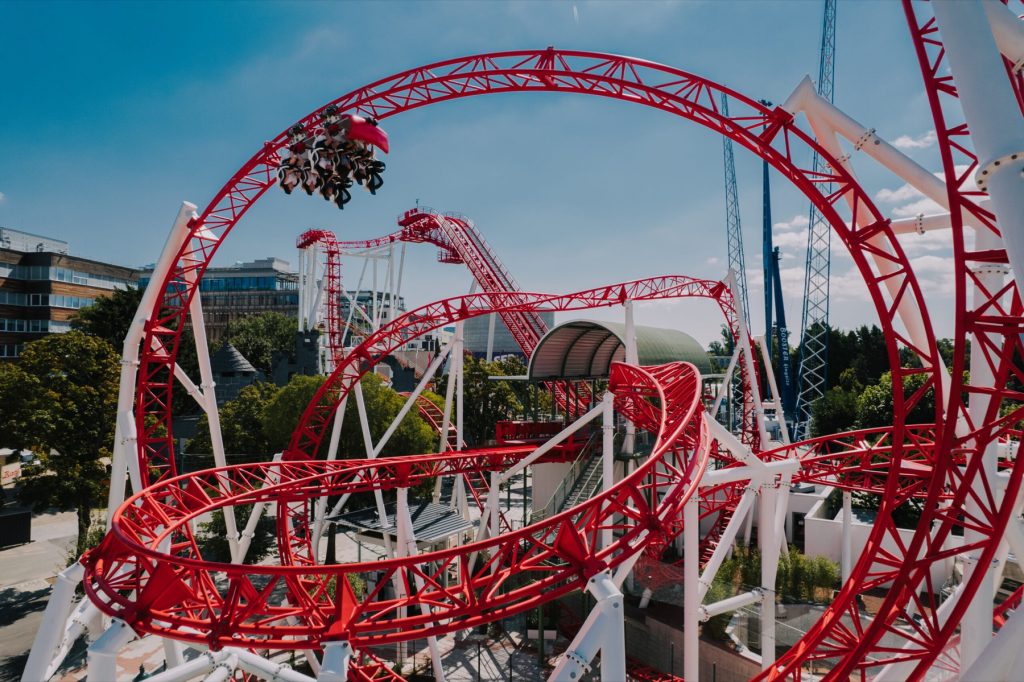
After comparing several manufacturers, we chose Mack Rides of Waldkirch, Germany, and its Big Dipper vehicle concept. Each car seats eight passengers, including outer seats positioned beyond the track, so riders on the edge have nothing but air beside them. This coaster type combines frequent dispatches, a compact footprint and a ride experience that stands out among dozens of competing rides.
02 · The site
A plot with a past
Space is the Prater’s scarcest resource. Since reconstruction after 1945, almost every free square metre has been built on.
The Prater is divided into mostly rectangular plots, each run by a showman with one or more rides of their own. The Wiener Looping’s site is nothing like that.
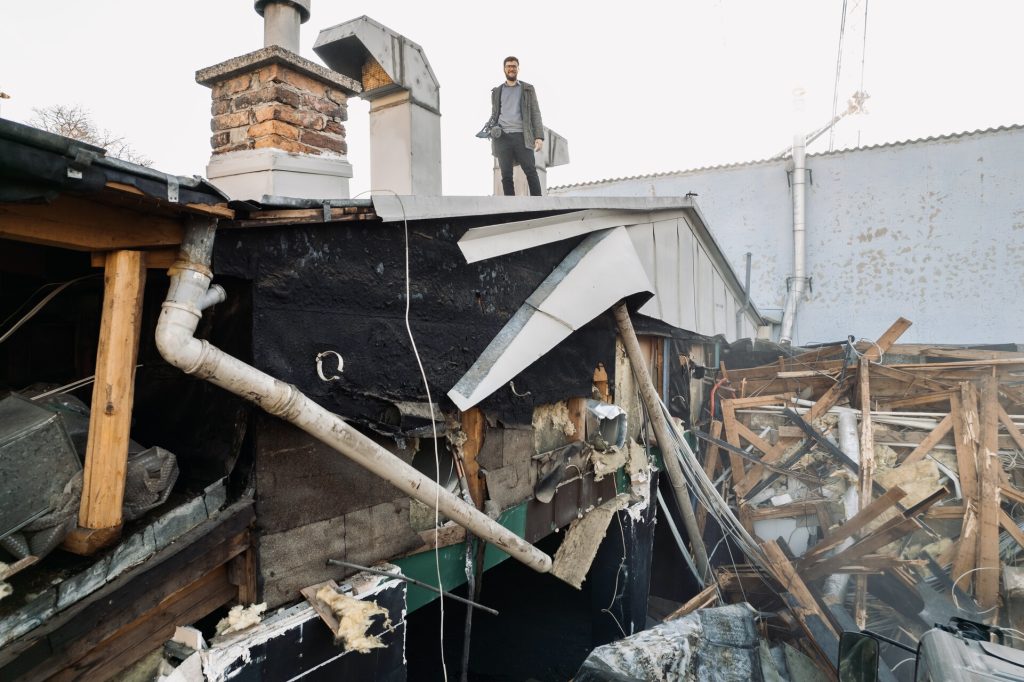
Over the decades it has been subdivided, merged and redeveloped again and again. What remained was a plot that was hardly made for a roller coaster.
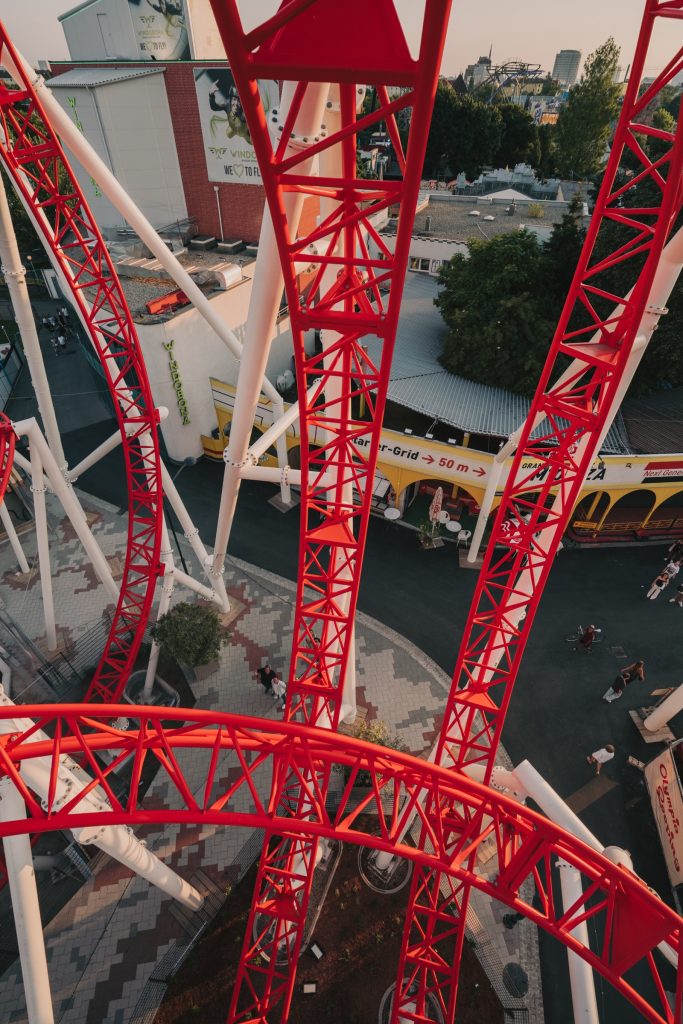
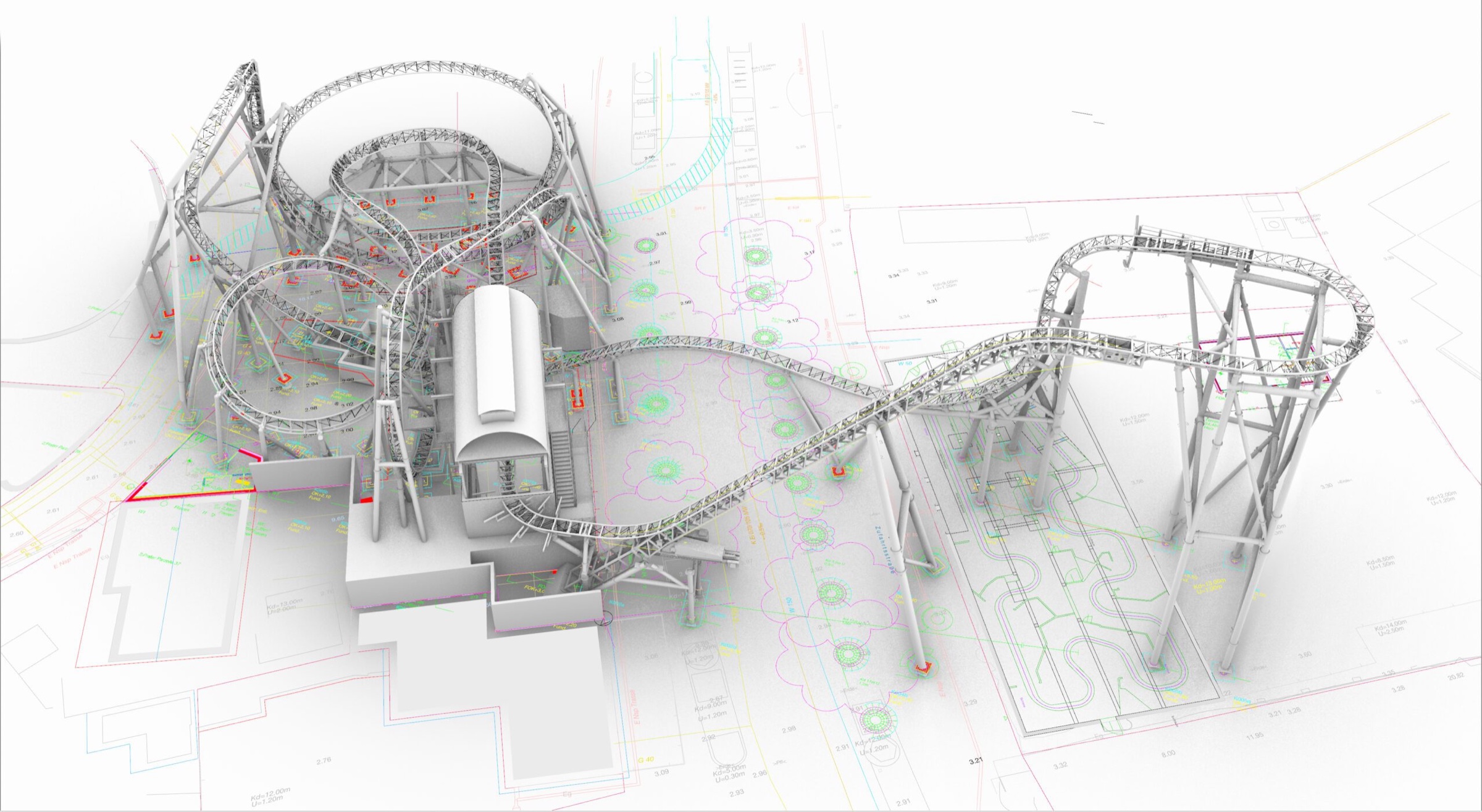
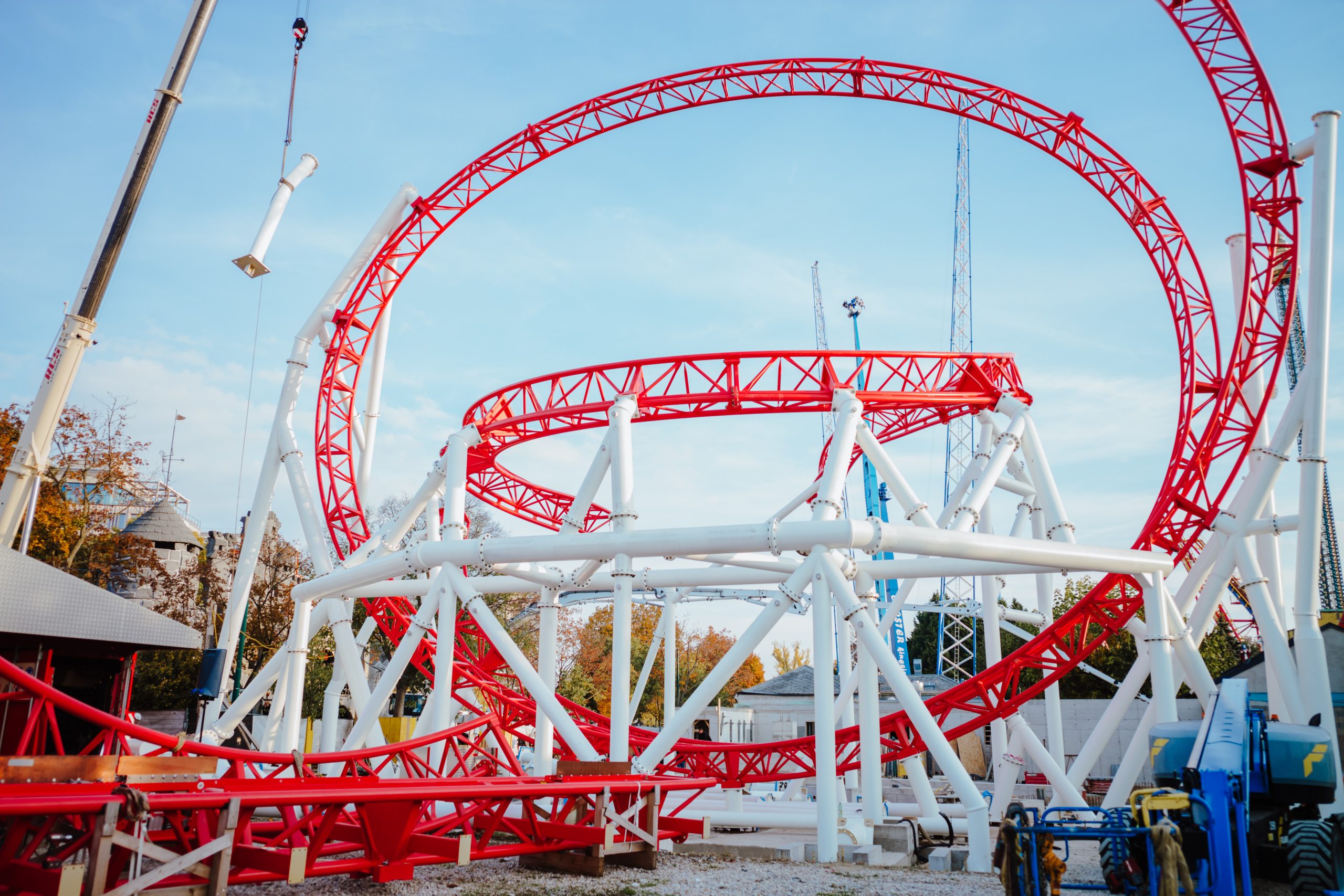
Instead of shrinking the ride to fit, we let the design reach beyond the plot’s boundaries. The track leaves the site in several places, crosses three public streets and ties a second plot into the layout.
Building over public ground on this scale had never been done in the Prater before, and it remains unique there. On paper the layout looks unusual. On site, it sits in its surroundings as if it had always been there.
The difficult site was never the obstacle.
It was the brief.
03 · The footprint
Where coasters waste space
Two elements are notoriously inefficient on a tight site: the lift hill and the final brake run. Both are usually long straight sections. Both take up a large share of the footprint, and neither adds a great deal to the ride experience.
On the Wiener Looping, both became tools. The lift hill leads away from the core of the site, freeing the centre for the elements guests actually see from the walkway.
The final brake run sits deliberately high: the car arrives more slowly after climbing into it, needs a shorter braking distance and therefore less track and less ground.
04 · The ride
The ride, element by element
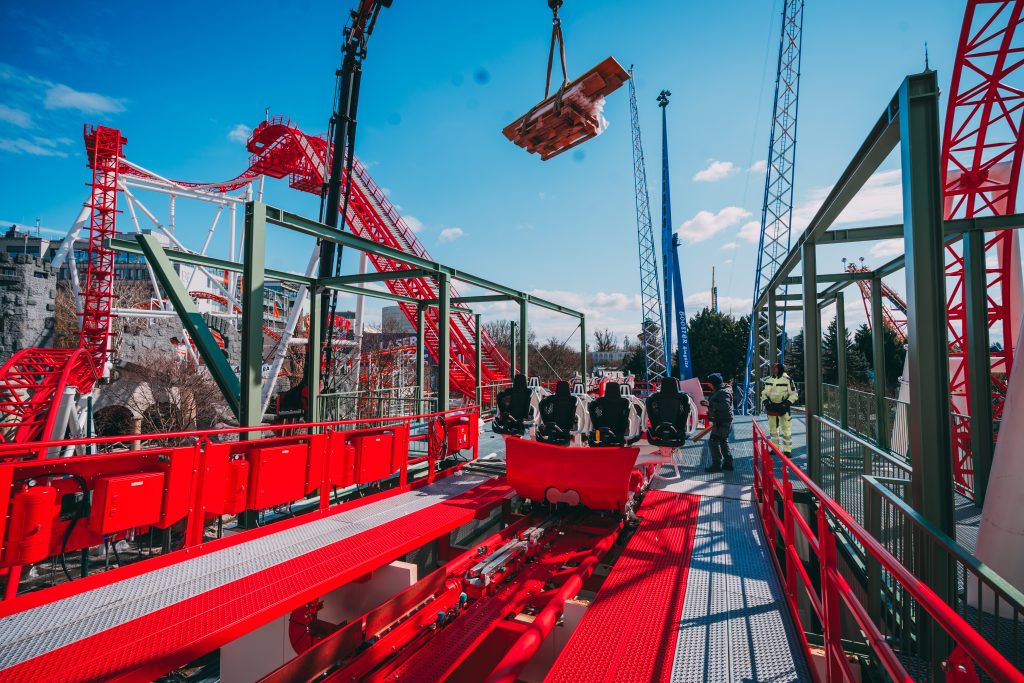
The car leaves the station in a left turn and climbs the lift hill to 31 metres. A panoramic curve at the top ends in a pause just before the first drop. It is a held moment with a view across Vienna and the Prater, and a deliberate build-up of tension.
- A 92-degree double down The first drop is beyond vertical, at 92 degrees. Unlike most coasters, it does not run straight to the ground. It breaks into a double down: the steep drop is followed by a camelback that delivers the ejector airtime enthusiasts look for, before the track falls again. This was not a stylistic choice alone. Directly beneath the first drop stands an existing ghost train. The double down clears the building and adds a moment of airtime the ride would otherwise not have had.
- The Banana Roll Coming back towards the main plot, riders face the tangle of track ahead of them. At the lowest point of the circuit the car reaches its top speed of 82 km/h and rises into the Banana Roll. The element is related to an inverted top hat, but its apex is tilted inwards; from the side, the curved silhouette gives it its name. Its function is simple: it turns the car around before the plot runs out.
- A loop that refuses to be quick Then comes the element that gives the ride its name. A conventional loop has its tightest radius at the top, so riders pass the inversion in a fraction of a second. The Wiener Looping stretches the top instead. The overhead section is lengthened until riders hang upside down in near-weightlessness for almost three seconds. The large radius has a second benefit: it leaves room for the final curve to pass straight through the loop later on. Two elements, one footprint.
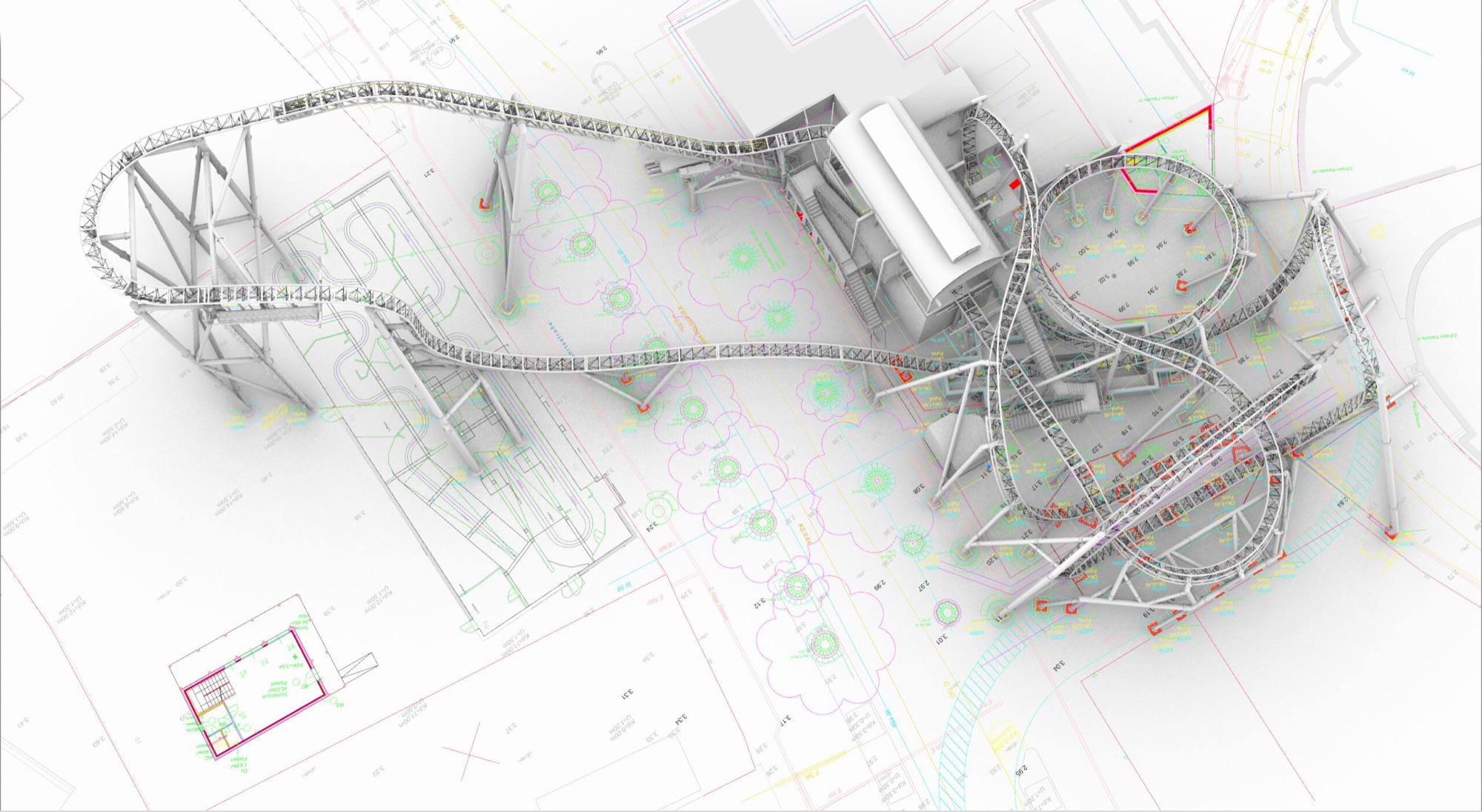
- The Monsieur-Sky-Roll The loop exit leads straight into the next transition. In a right turn the track climbs steeply, banks to 104 degrees, then rolls 284 degrees to the left and drops into a dive loop right next to the station. Where the loop floats, this element ejects: riders are lifted out of their seats mid-twist. What I had in mind was the sensation of a so-called non-inverting loop. The name came from the ride’s owner, Stefan Sittler-Koidl.
- Helix, twist and a final surprise After the dive loop comes an overbanked turn, a tribute to the original Wiener Looping, which feeds into a forceful helix. A twisted airtime hill at 12 metres leads into the final turn, which threads through the centre of the loop. Its exit holds one last surprise, inspired by Dæmonen at Tivoli Gardens in Copenhagen: instead of a final airtime hill before the brakes, the track snaps out of the banked turn into the straight in one fast twist, and the car shoots into the brake run.
05 · The finale
Time for a Brake
The final brake is rarely discussed. On most coasters, it is a functional afterthought at the end of the layout. On the Wiener Looping, it got the same attention as every other element.
The position: the final brake sits at the eye level of the guests waiting to board. They see the faces of riders who have just come back from their adventure – the laughter, the disbelief, the adrenaline. Their ticket is already bought, but nothing builds anticipation like that moment. Emotion becomes marketing, at no cost.
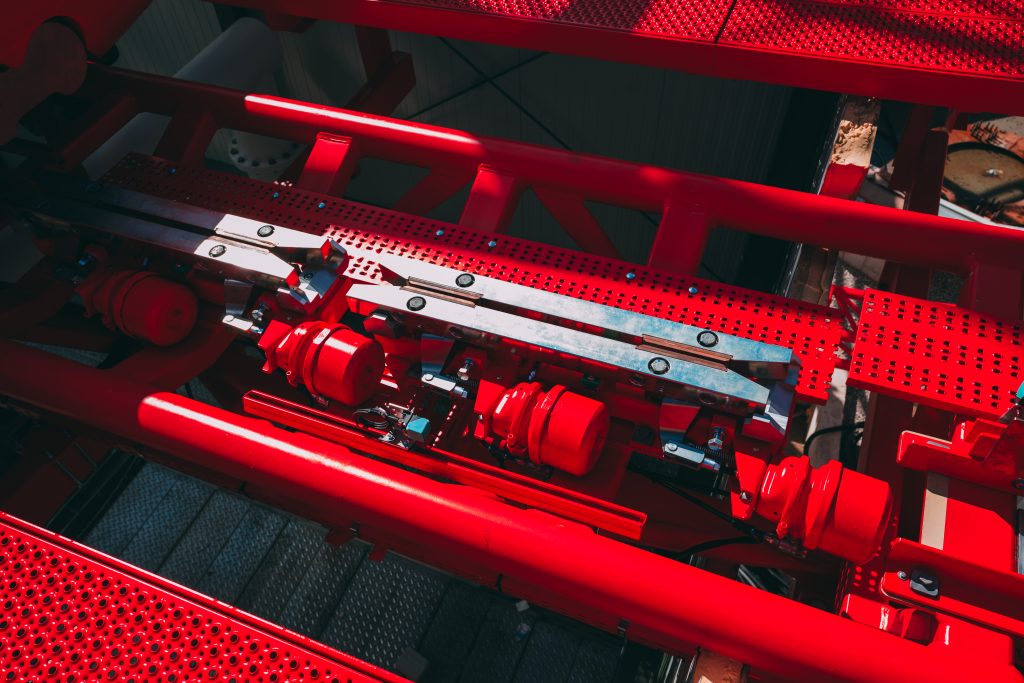
From the brake, the car returns directly to the station, with no detours and no unnecessary track. That keeps the total cycle time as short as possible, and on a ride with frequent single-car dispatches, every second saved per cycle adds up over a full operating day.
Then, the riders themselves. Guests who step out while they are still energised move faster. They unbuckle, stand up and leave the car more quickly than riders whose excitement has already faded on a looong return track. A shorter return keeps that energy alive, speeds up unloading and increases throughput.
One element, three effects: more excitement in the queue, shorter cycles and higher capacity.
06 · Looking back
The bold decisions
Looking back, the ride’s best moments all started as problems. The ghost train gave us the double down. The street gave us the Prater’s first coaster built over public ground. The lack of space gave us a loop that shares its footprint with the final curve. Every metre, every second and every emotion had to earn its place.
The boldest decision, however, was made before any track was drawn: to invest in a permanent new landmark and bring a quieter part of the Prater back to life. It was a decision driven by belief in the place – and in what a strong ride can do for everything around it..
Planning a new attraction on a site that seems too difficult? That is exactly the kind of project I enjoy. Get in touch
Next in this series All-Out on Red: the business case behind the Prater’s first modern flagship coaster