Plattform 9

Plattform 9
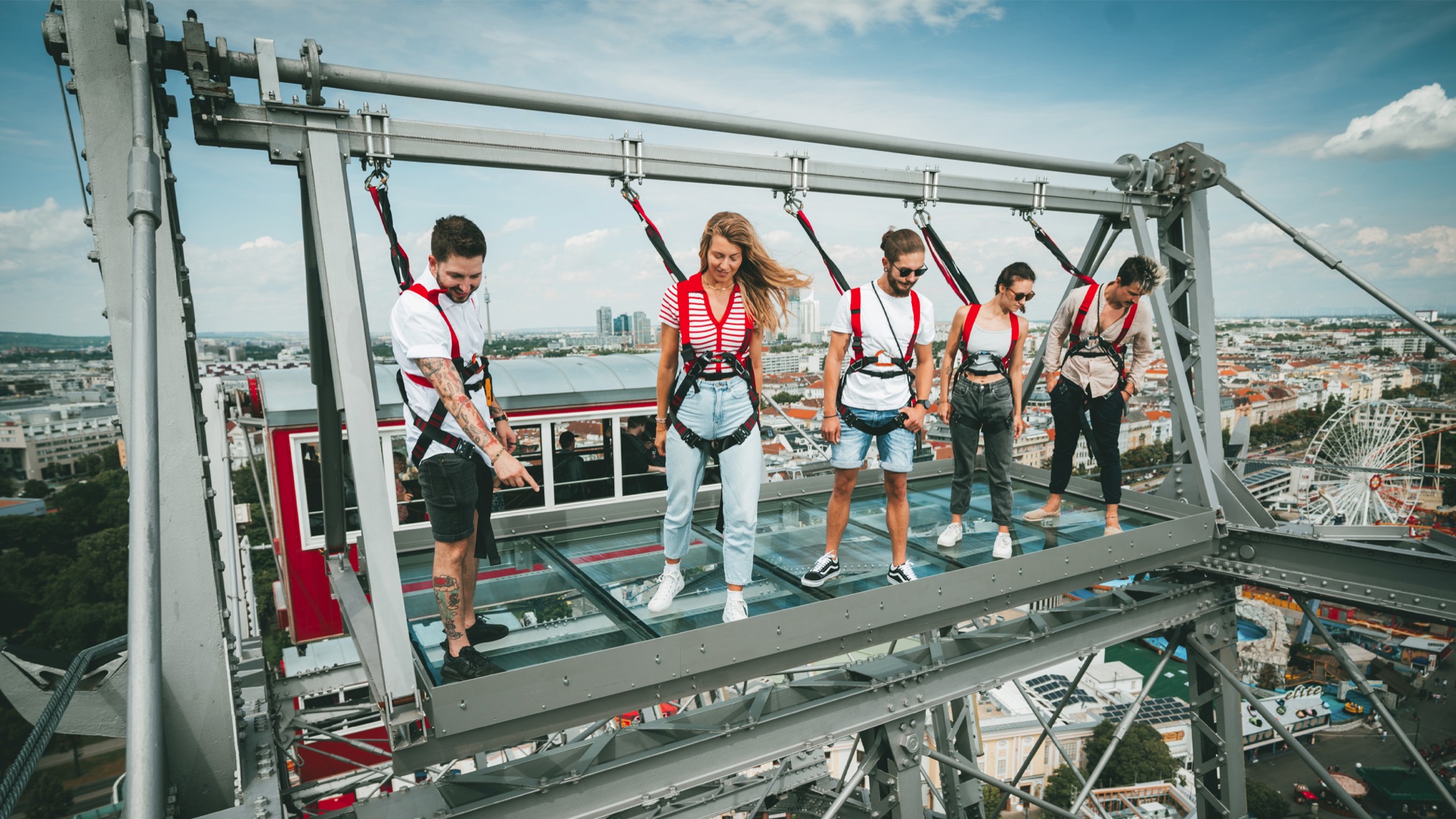
A rooftop ride on a wagon of the Giant Ferris Wheel – turned into an experience for the public.
By Julian Omonsky · Vienna, Austria
There are a few ways to experience the Vienna Giant Ferris Wheel. On a beautiful summer evening in 2020, just after the Wheel had closed for the day, I seized the opportunity to embark on one of the most spectacular Ferris Wheel rides imaginable.
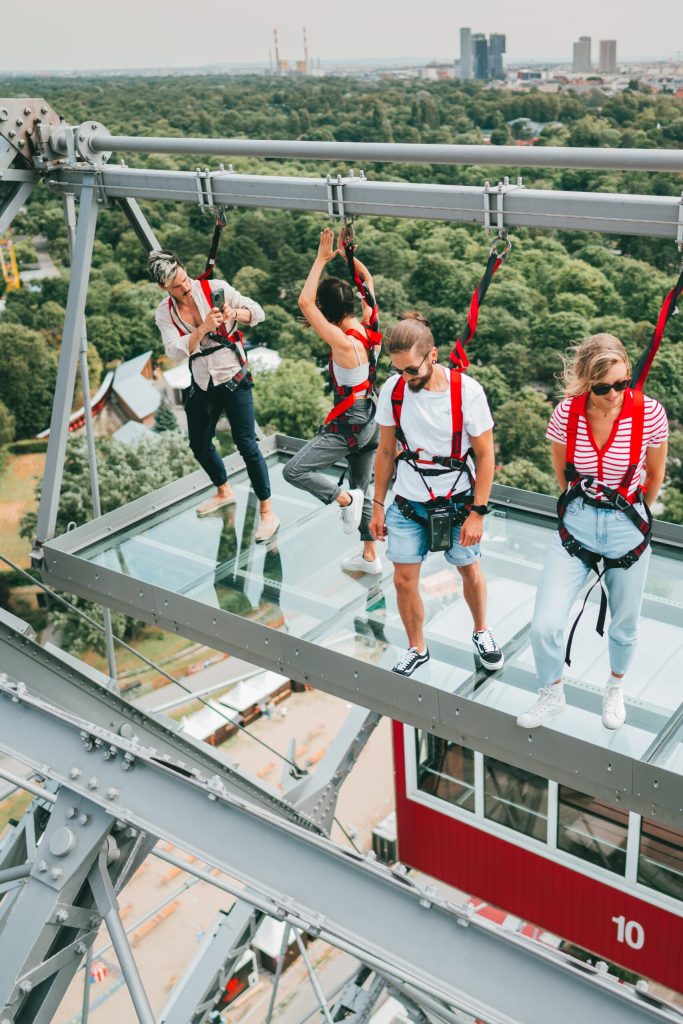
The typical way to take a ride on the Vienna Giant Ferris Wheel is in one of its 15 wagons. Each offers a great view of the city of Vienna. Since 2022, there has also been Plattform 9.
01
A ride on the roof
However, a third option is to ride atop the roof of one of the actual wagons – and that’s how new ideas evolve!
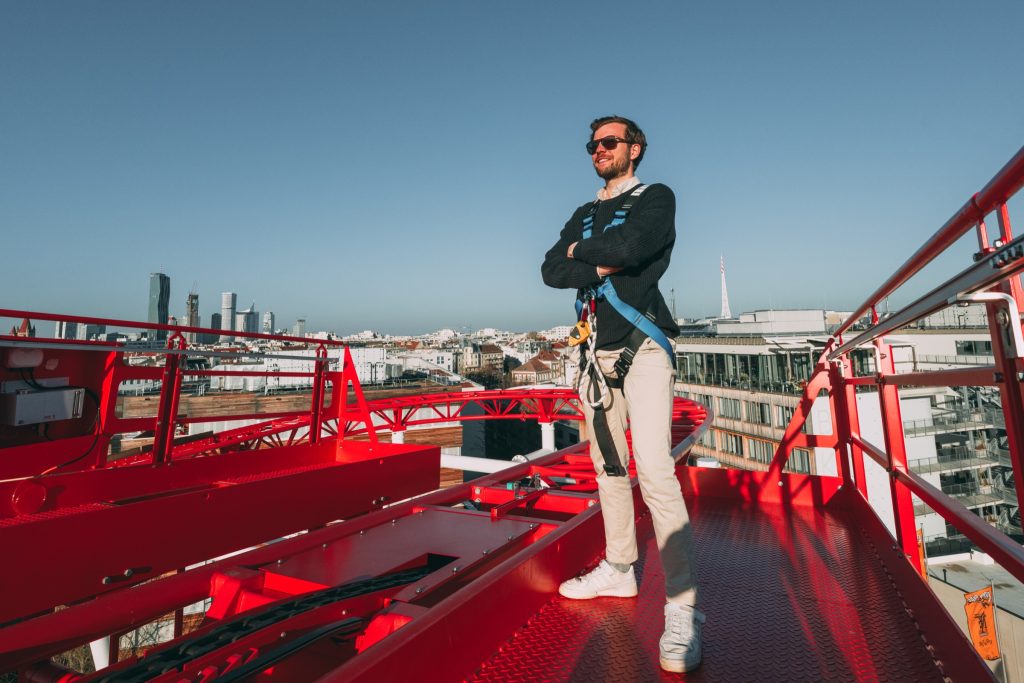
With a safety harness securely fastened, the owner and I ascended into the Vienna night sky.
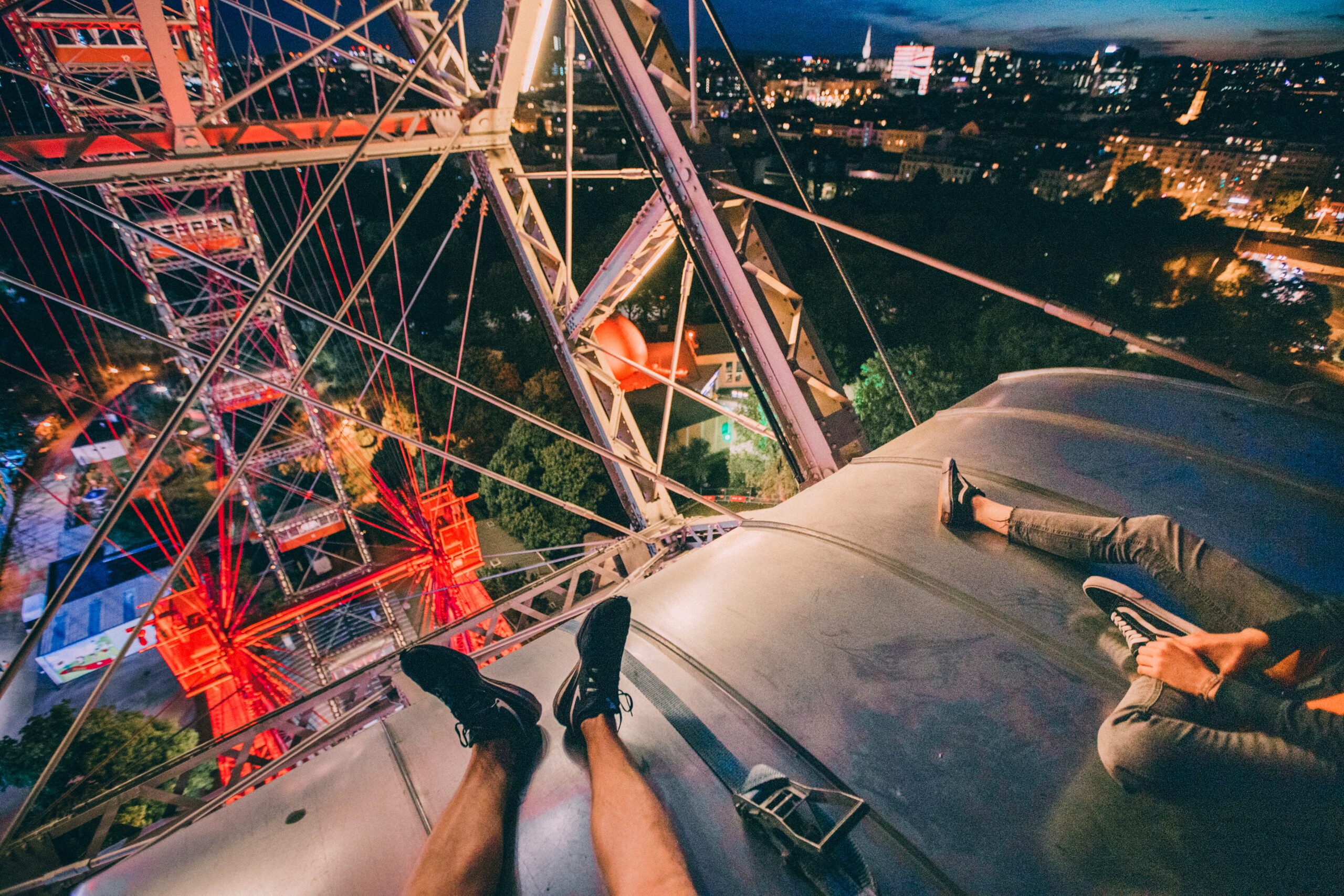
Surrounded by silence, we beheld the twinkling lights of the Vienna Prater and the magnificent skyline of the city itself.
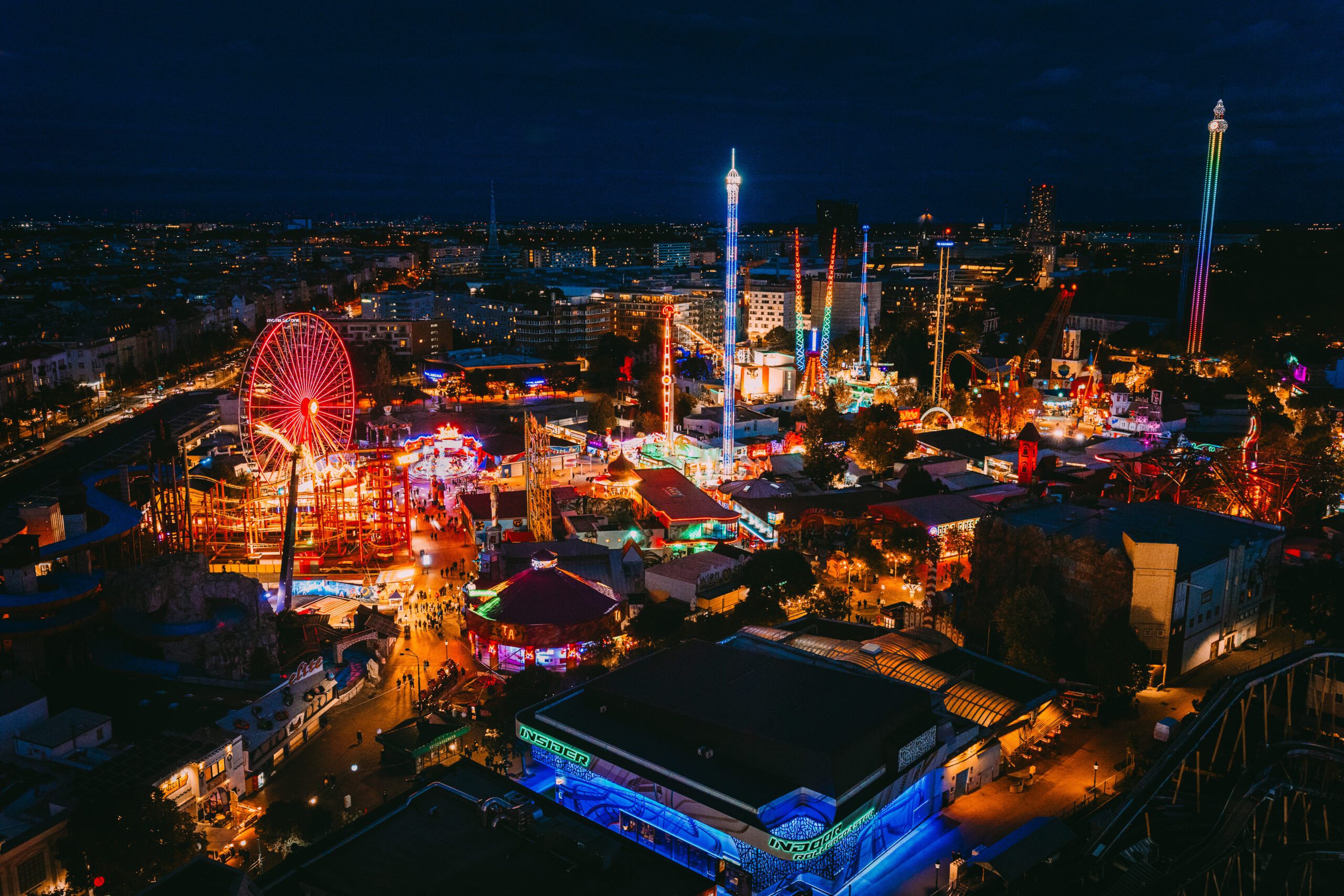
Shortly thereafter, we both recognised the potential to offer a similar experience to the public. It eventually resulted in an experience ALMOST as good as the actual rooftop ride itself. Well, almost… because some things are just meant to be kept special and close to the heart.
02
From swings to a better idea
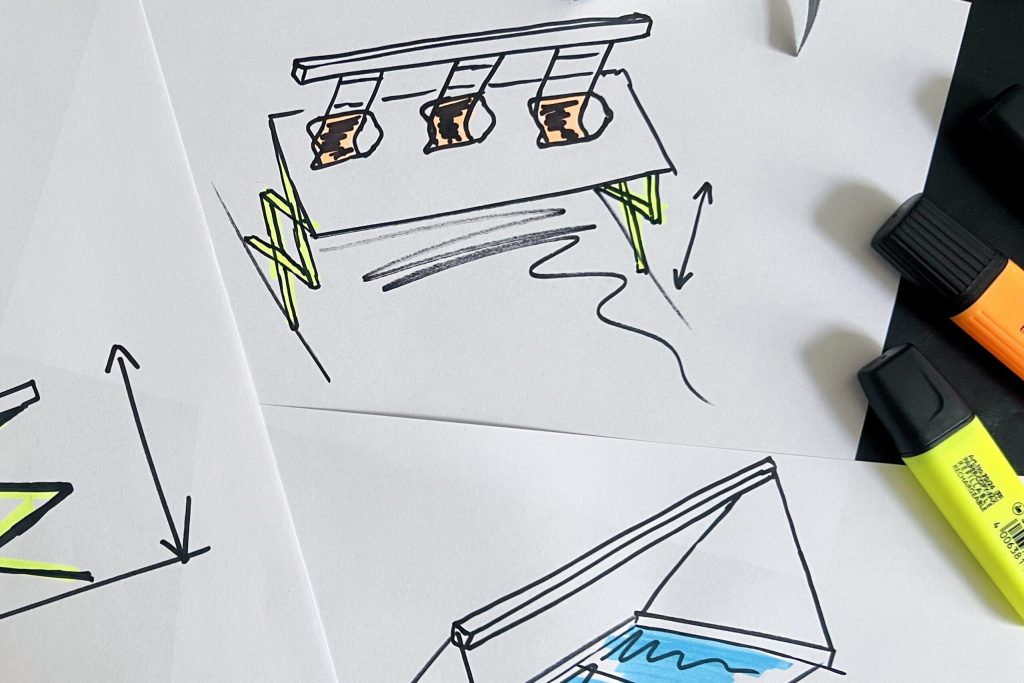
The major challenge was to minimise disruption to regular operations while ensuring that we could offer a comparable experience to the breathtaking rooftop ride.
The idea of adding swings was initially a good one, but it required an adaptable moving floor to facilitate easy boarding at ground level. Furthermore, with swings, you can only face in one direction, limiting the view.
In the end, incorporating the necessary lift table into the existing setup posed logistical and budgetary constraints. Pursuing this way would have made the project significantly more complex and considerably more expensive. So, I kept on thinking about how to implement a similar experience effectively.
03
The solution is a glass platform
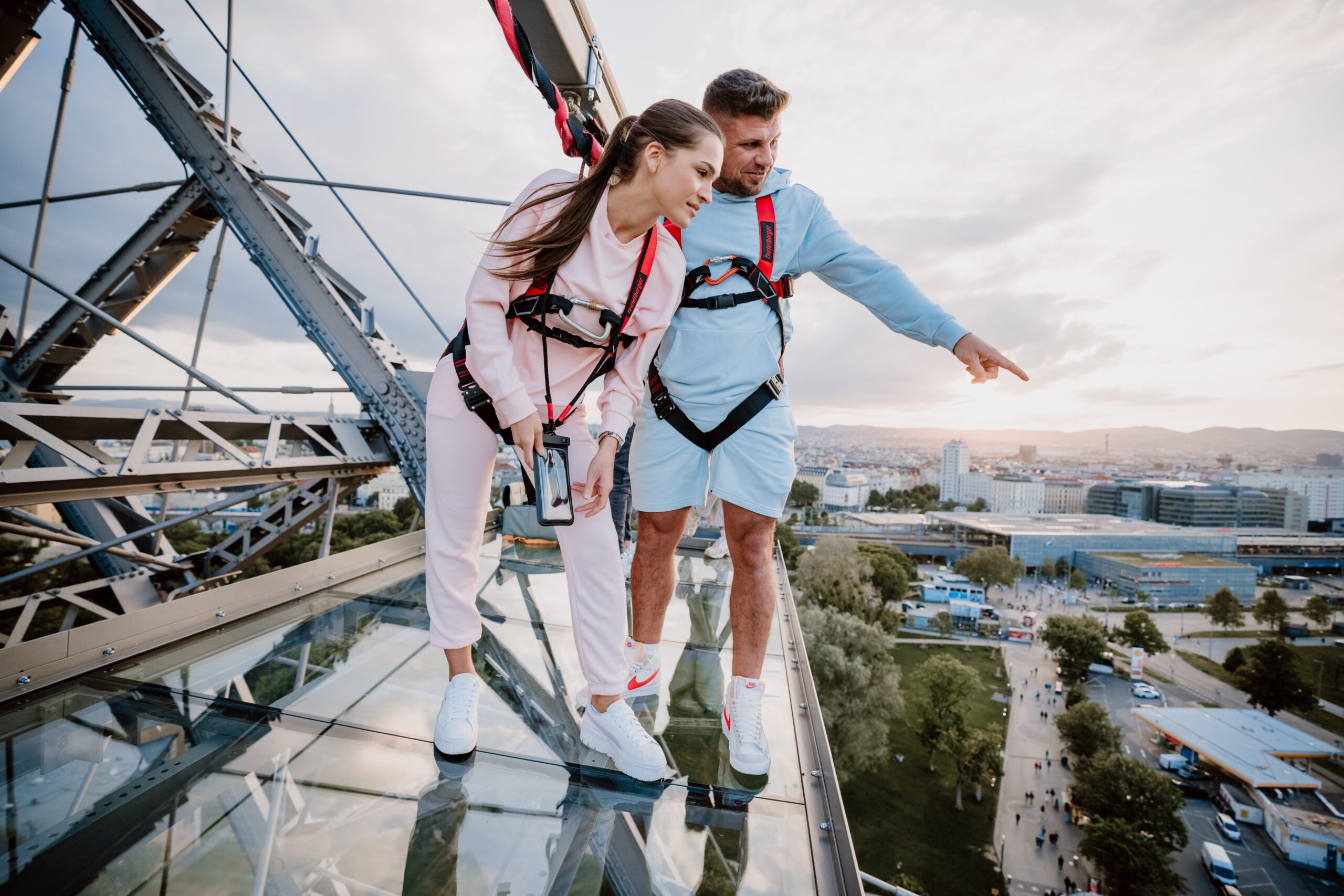
The glass platform solves all problems and is easy to use within regular operations.
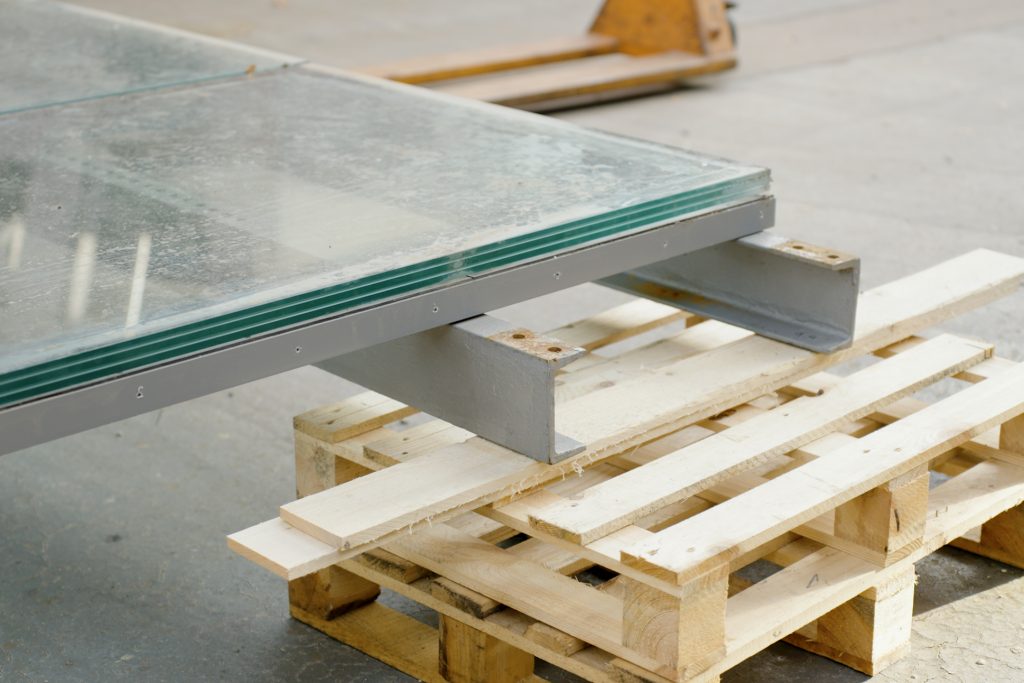
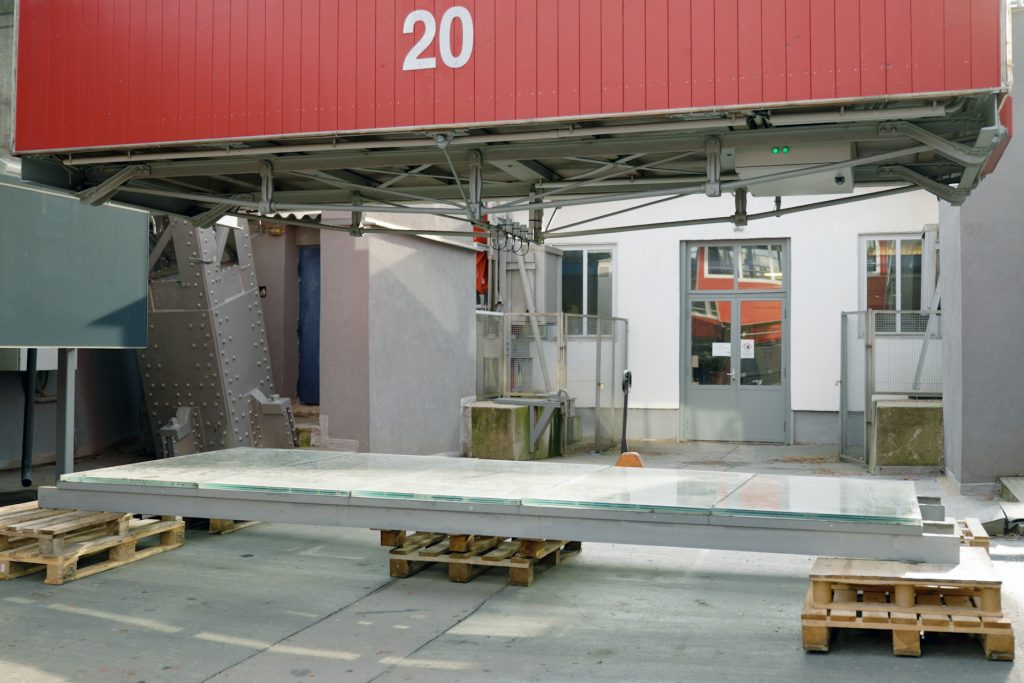
- Pick-up Guests arrive at the Vienna Giant Ferris Wheel and are picked up by a tour guide.
- Harness The guide helps guests put on their safety harnesses and stays with them during the entire journey.
- Briefing After a quick safety briefing, guests step onto the platform and attach to a safety cable to reach their spot.
- Ready The guide secures the safety harness to the final attachment point, and the journey is ready to begin.
For the next few minutes, guests encounter a truly unique experience.
04
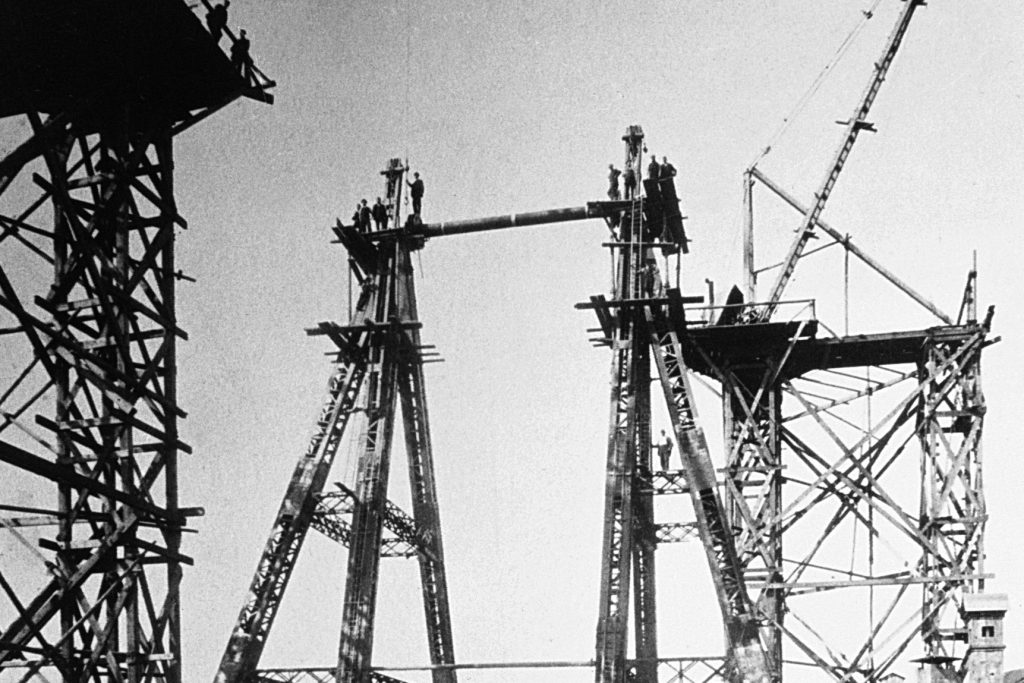
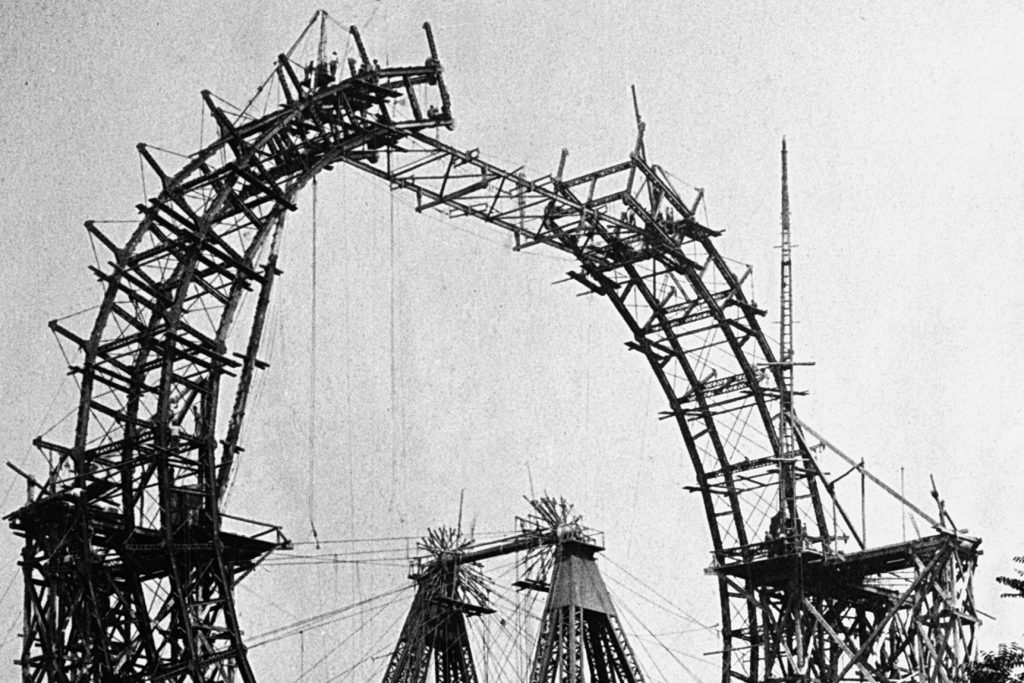
Dedicated to the construction workers of 1897
At Plattform 9, guests discover a truly unique experience, dedicated to the construction workers who erected the Wheel in 1897. The ride offers the only way for the public to truly grasp the challenges of working at heights of about 64 metres.
- 1897The Wheel is erected
- ~64 mWorking height
- 15Wagons
- 2022Plattform 9 opens
- 125Years of the Wheel
Side fact: body belts, the predecessors of safety harnesses, only gained popularity in the 1920s – more than two decades after the Wheel was built. Keep this in mind as you enjoy your ride.
05
Plattform 9 has gained significant attention
The new experience was launched just in time for the 125th anniversary of the Vienna Giant Ferris Wheel. Moreover, it served as a successful promotional tool for “The most spectacular job in Austria” campaign, as well as for various other marketing collaborations and promotional events.
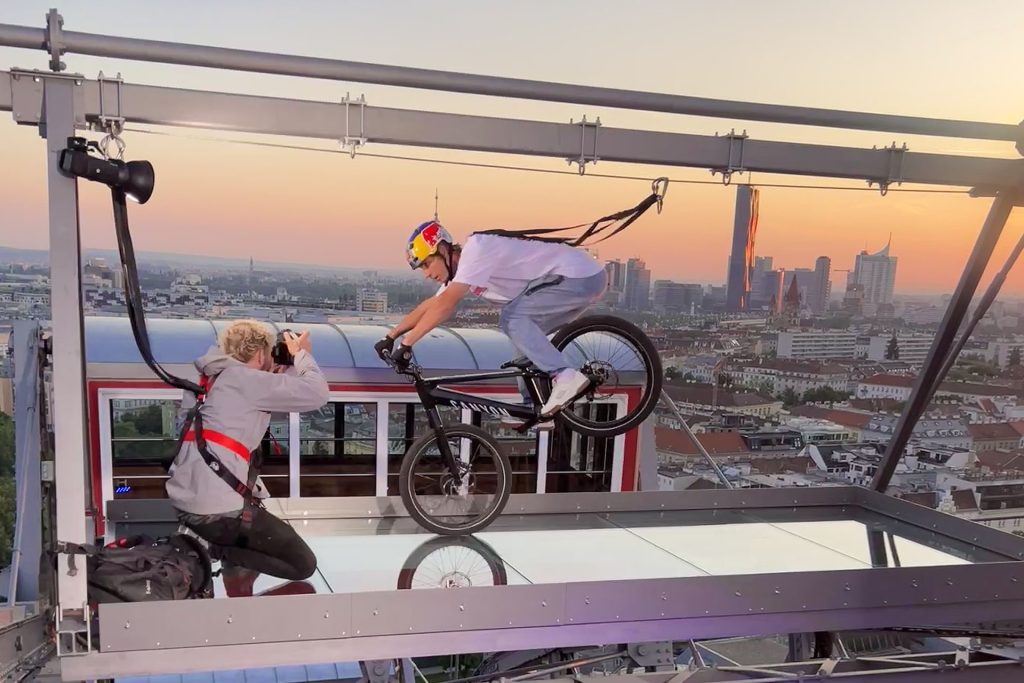
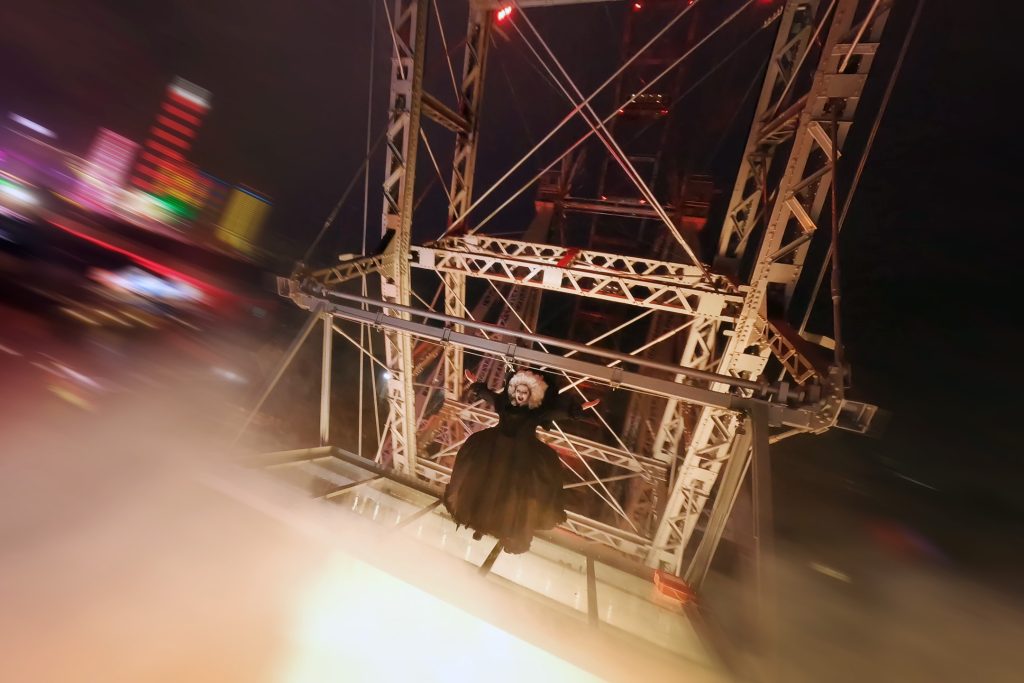
Plattform 9 expands a tradition dating back over 125 years with a breathtaking new innovation.
In summary, Plattform 9 is a major success for the Vienna Giant Ferris Wheel. It is the perfect symbiosis of tradition and modernity, seamlessly fitting into the overall portfolio of the Wiener Prater.
Looking for a new experience within an existing attraction? I help operators turn ideas like this into something guests can book. Get in touch
Mini Montanha Hilda
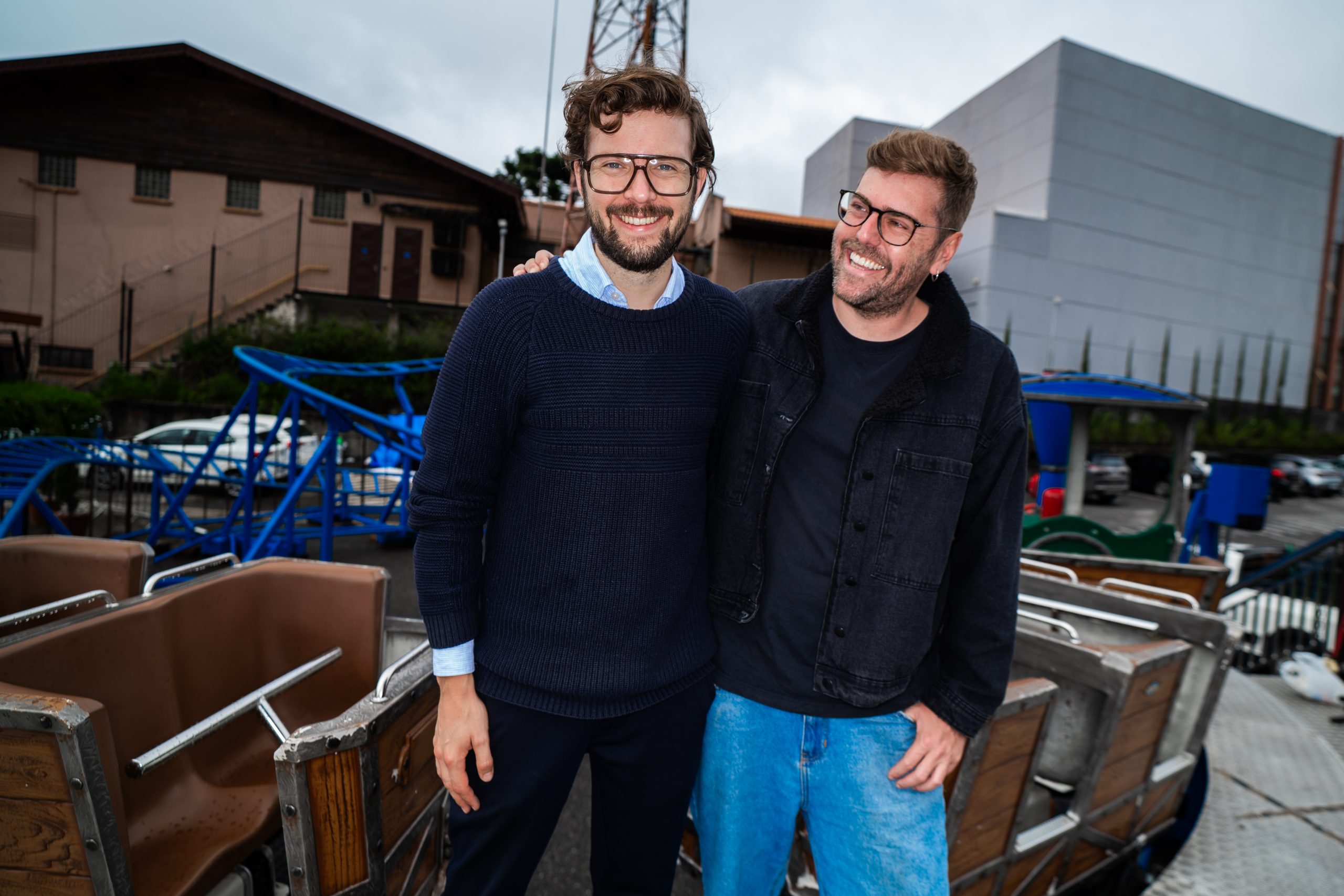
Racing the season
How a coaster from Bavaria reached Brazil’s highest town in under four months.
By Julian Omonsky · Campos do Jordão, Brazil
From an indoor park in Cologne via Munich and the Bavarian Alps to Parque Capivari in Campos do Jordão: the story of a small coaster that found its fourth home across the Atlantic. It cleared customs after a piece-by-piece inspection and became the favourite ride of the park’s youngest guests.
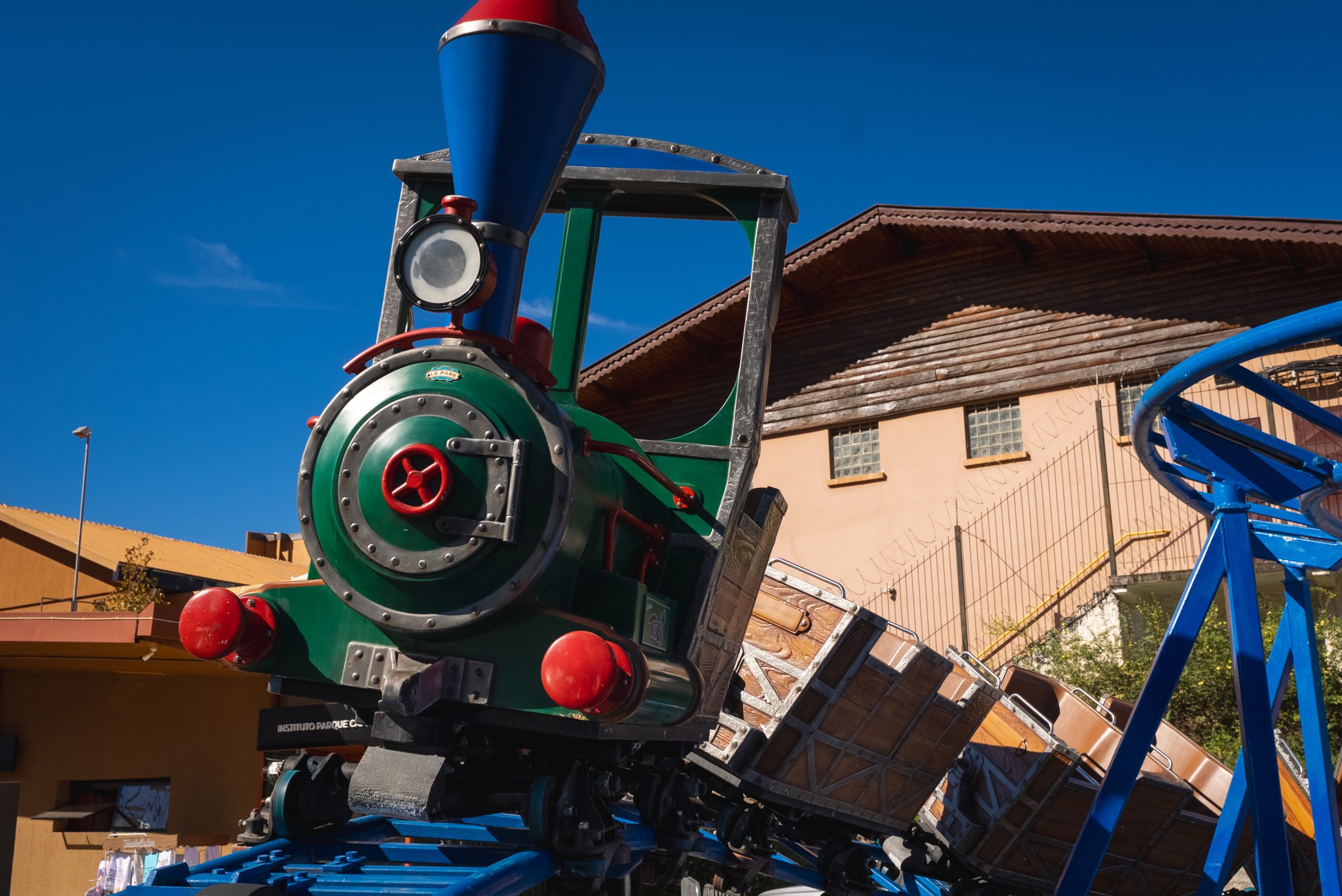
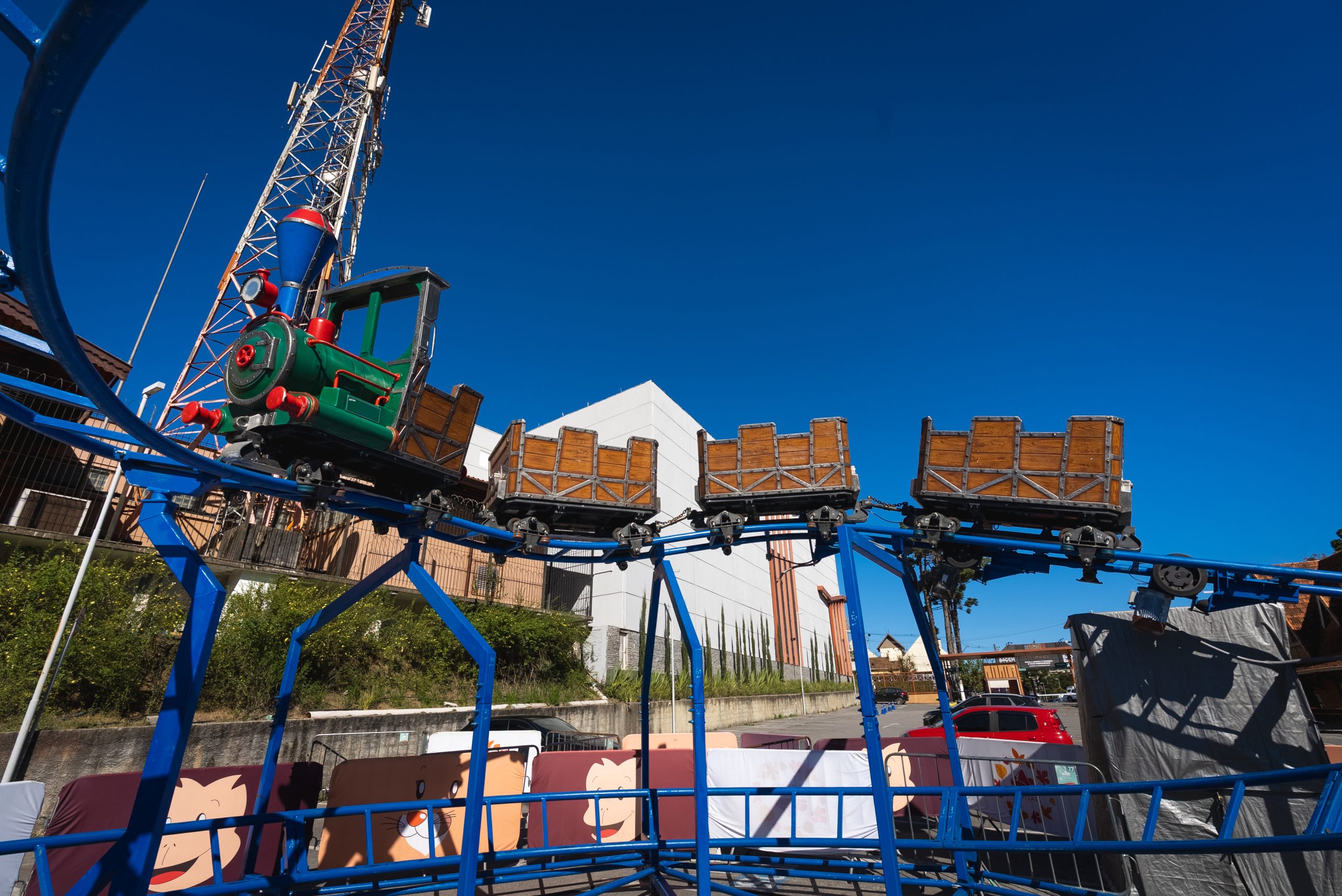
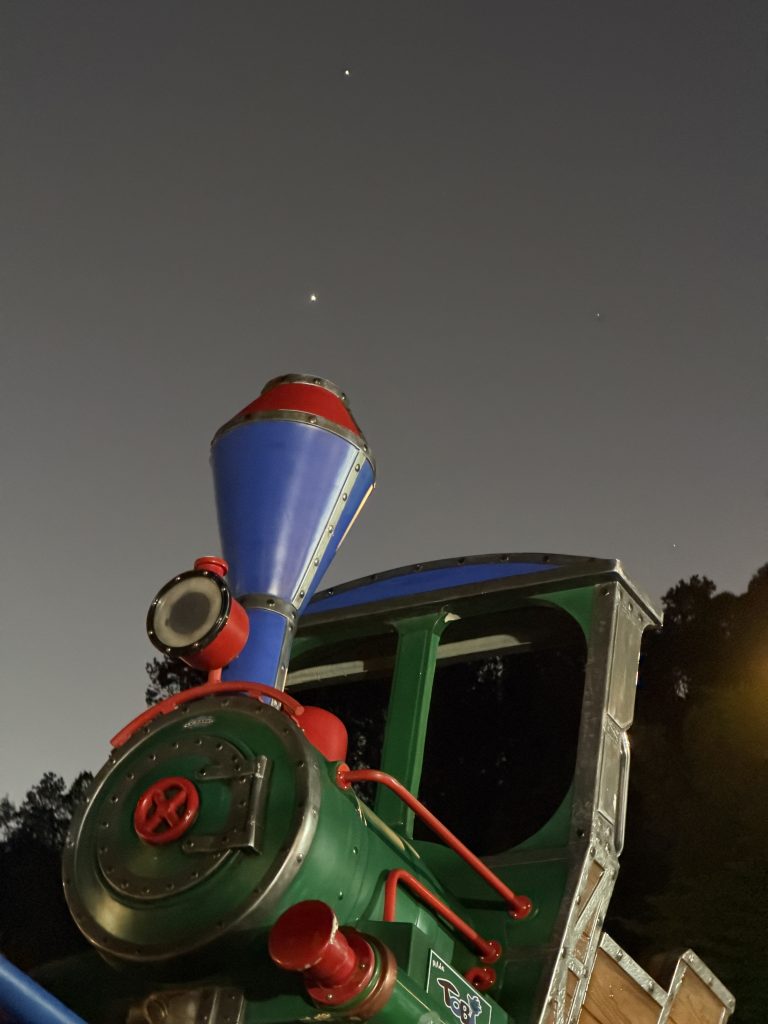
On 6 June 2026, a small locomotive-style train left its station at Parque Capivari for the first time with paying guests on board. Three and a half metres high, 60 metres of track, a few laps around a water fountain. By industry standards, it is a modest ride. For the children of Campos do Jordão, it is their first real roller coaster – and for me, one of the most intense projects I have worked on.
Less than three and a half months earlier, the same coaster was still standing in Bavaria.
01 · The gap
A family coaster for all ages
Campos do Jordão sits at 1,628 metres in the Serra da Mantiqueira and is Brazil’s highest town. Parque Capivari lies at its centre, with a cable car running up a small hill. Like the Prater, it charges no admission: guests pay for each individual attraction.
That was one reason the site appealed to me. From my work in the Prater, I know this system and its guest behaviour very well.
The park already had a strong coaster-like attraction: an alpine coaster that uses the slope of the hill. But on an alpine coaster, riders control their own speed with a lever they push forward. That works for adults and older children. For the youngest guests, it does not.
The park was missing an attraction for small children. A compact family coaster filled that gap exactly.
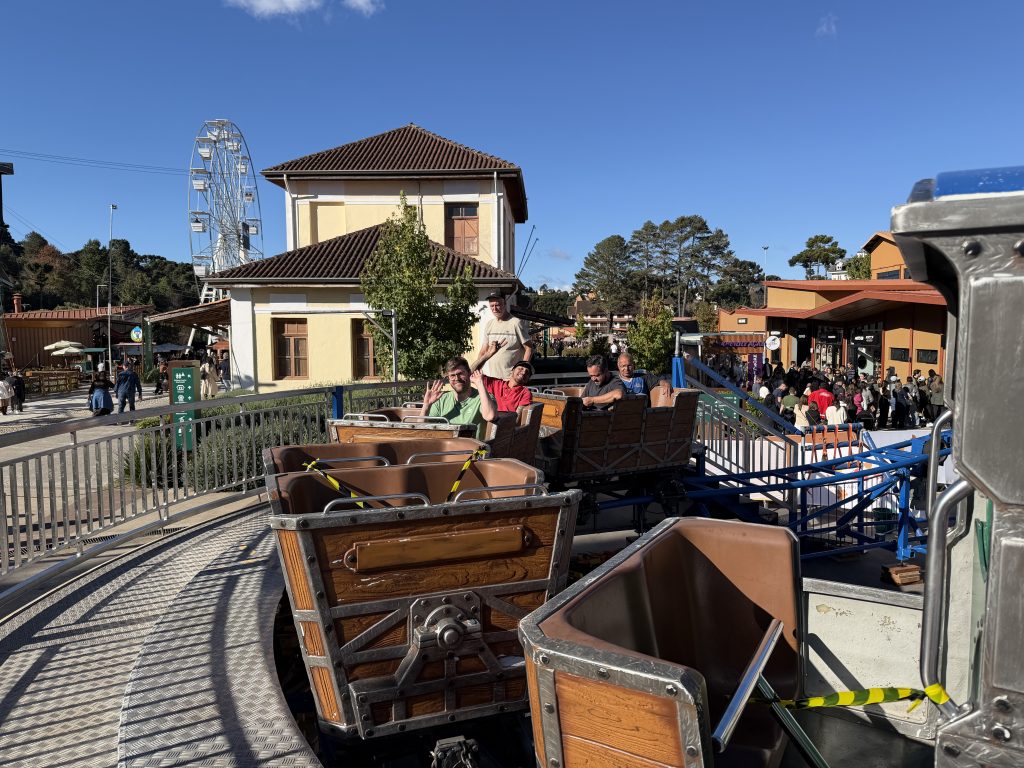
Real coaster feeling – without a minimum age that excludes half the family.
02 · The purchase
Why second-hand
A new coaster would have taken months to build before it could even be shipped.
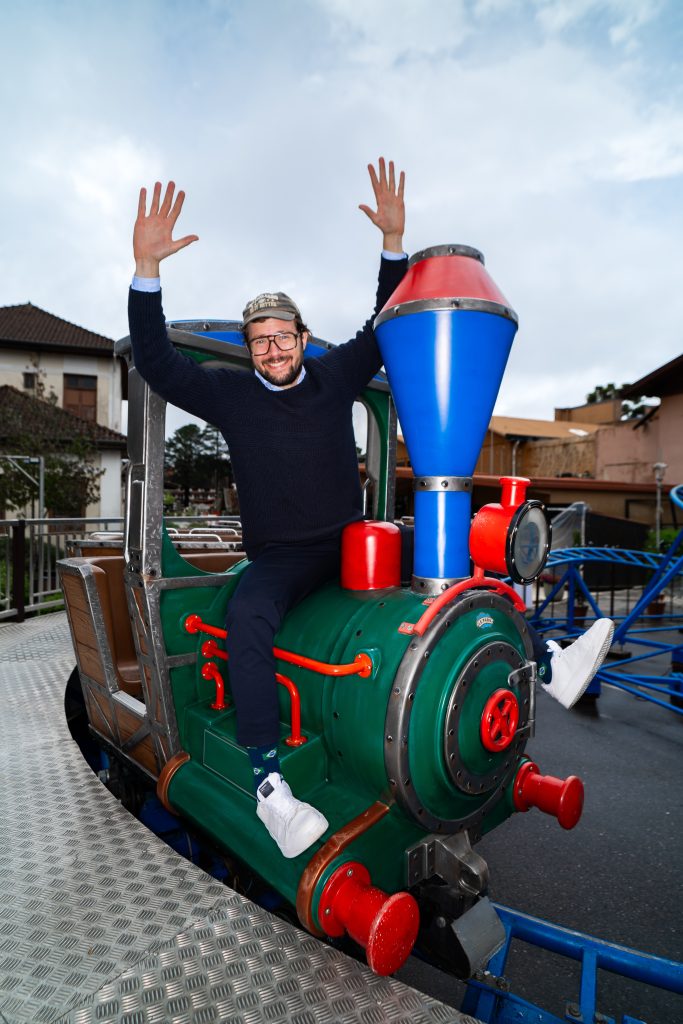
A used coaster in good condition was available immediately, had a proven operating history and fitted the budget.
The ride is a compact kiddie coaster by the Italian manufacturer I.E. Park, a Mini OTTO with a custom layout: one train of four cars, sixteen riders. Campos do Jordão is already its fourth home.
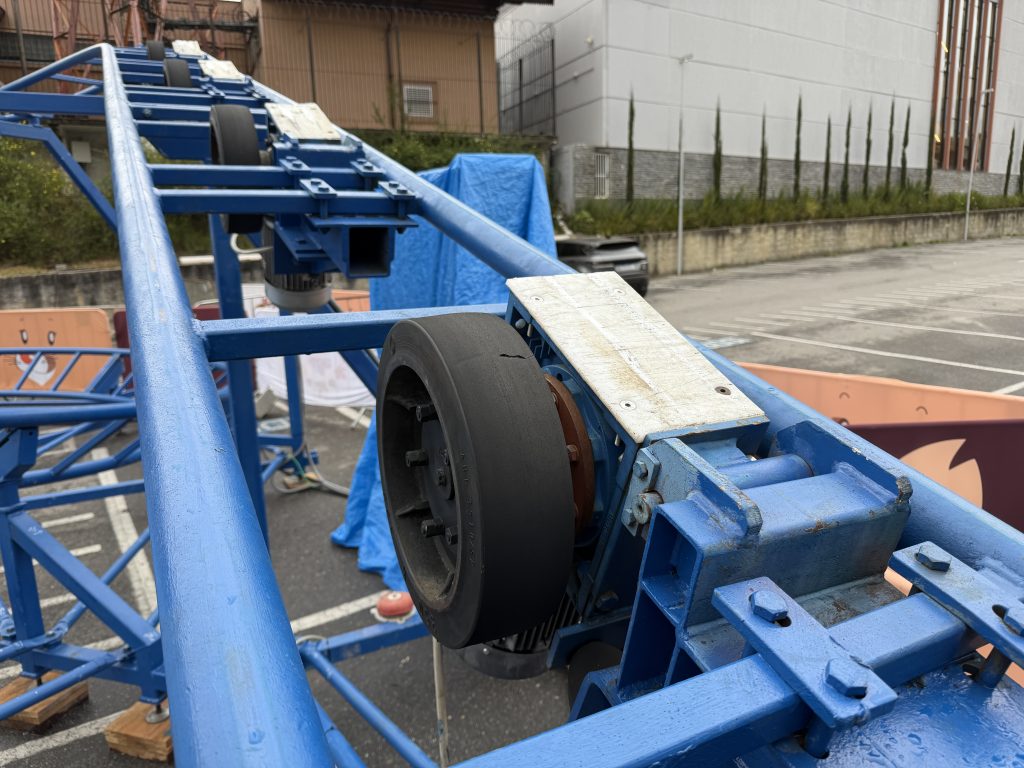
What surprised me most was how robust the ride is. It had spent many winters outdoors in Bavaria, through deep frost. Apart from one gearbox with a crack and the usual wear parts – wheels and drive tyres – it was in good shape.
- 2003 · Cologne Its story began at Tobiland, a large indoor play park, where it ran as the Tobiachterbahn.
- 2007 · Munich It then moved to the Lollihop and became the Wilde Mini Maus.
- 2014 · Bad Tölz At the Blomberg in the Bavarian Alps it operated as the Blombini-Express.
- 2026 · Campos do Jordão At Parque Capivari it now runs as Hilda’s Mini Mountain.
Four homes, two continents – and still running.
03 · The schedule
The season sets the deadline
The biggest challenge was not engineering. It was time.
Campos do Jordão’s high season is the Brazilian winter, from June to August, with July as its peak. To recover the first costs and to see how guests responded, the coaster had to be running before the season began.
That left less than three and a half months for everything: purchase, dismantling, export, ocean freight, customs, inland transport, assembly and commissioning.
The only way to make that work was to prepare everything in advance. Dismantling plan, crew, packaging, container and documents were organised before the deal was closed. Once the final details with the seller were agreed, I only had to pull the lever, and the whole chain started moving. The time saved at this stage was exactly the buffer we needed later.
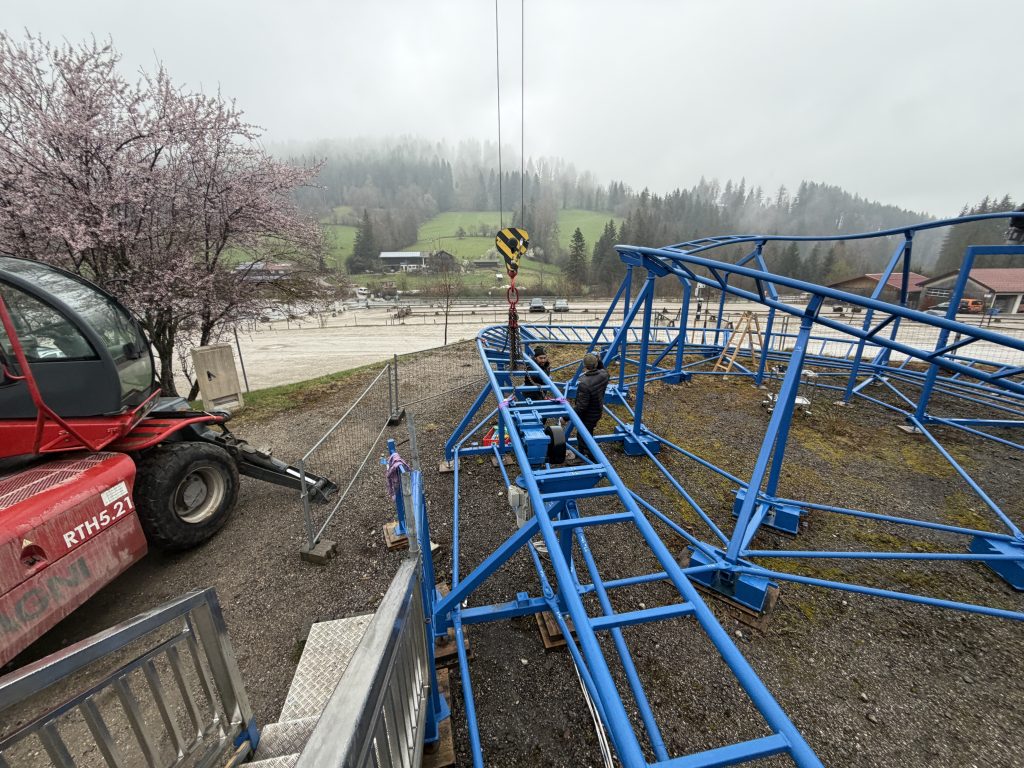
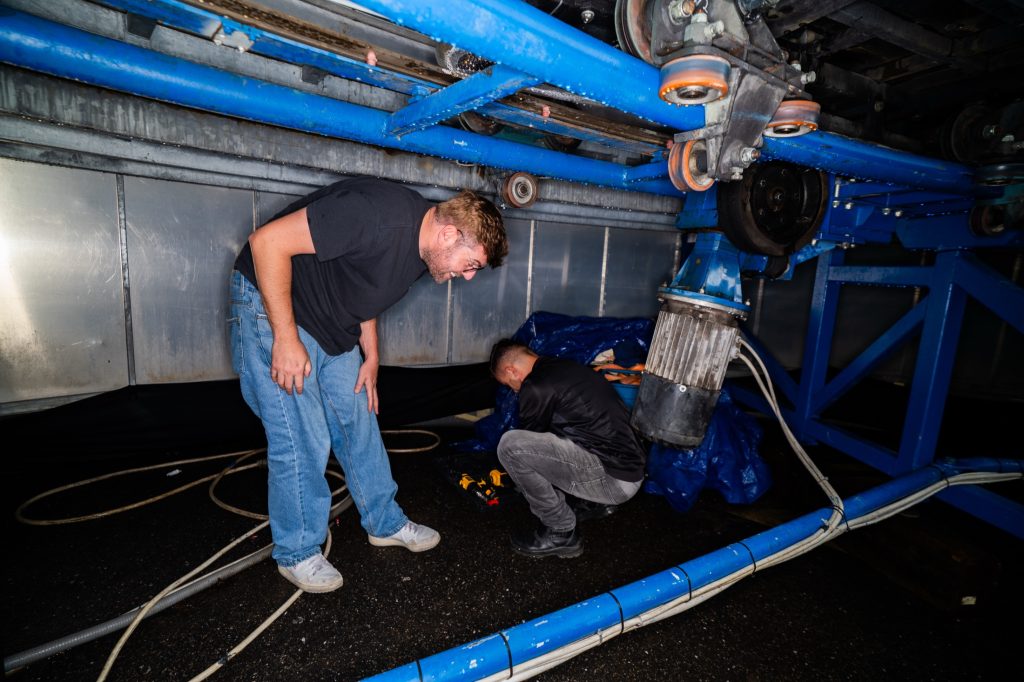
Dismantling in the Bavarian rain. The dismantling went to plan – apart from the weather. Several days of rain slowed the work, but my crew stayed on schedule. The container was loaded on time and released for the truck to the port of Hamburg.
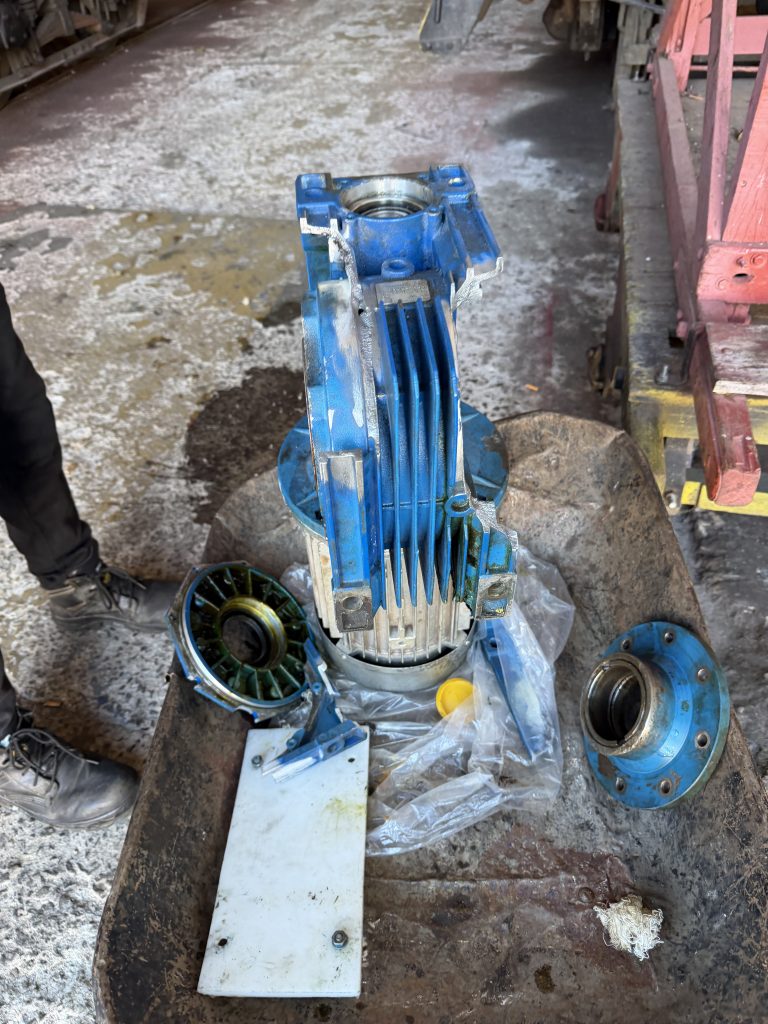
It also brought a first surprise. When we turned over one of the track sections that carry the drive tyres, gear oil began to leak: the gearbox had a crack. We drained the oil before it went into the container. The repair would have to wait for Brazil.
04 · The crossing
Four weeks of letting go
Then came the part every project manager dislikes: waiting. For about four weeks, the container was at sea between Hamburg and Santos. Once a container is sealed and on the ship, the project is out of your hands. There is nothing left to optimise, only to trust the preparation. I can confirm: it is an uneasy feeling.
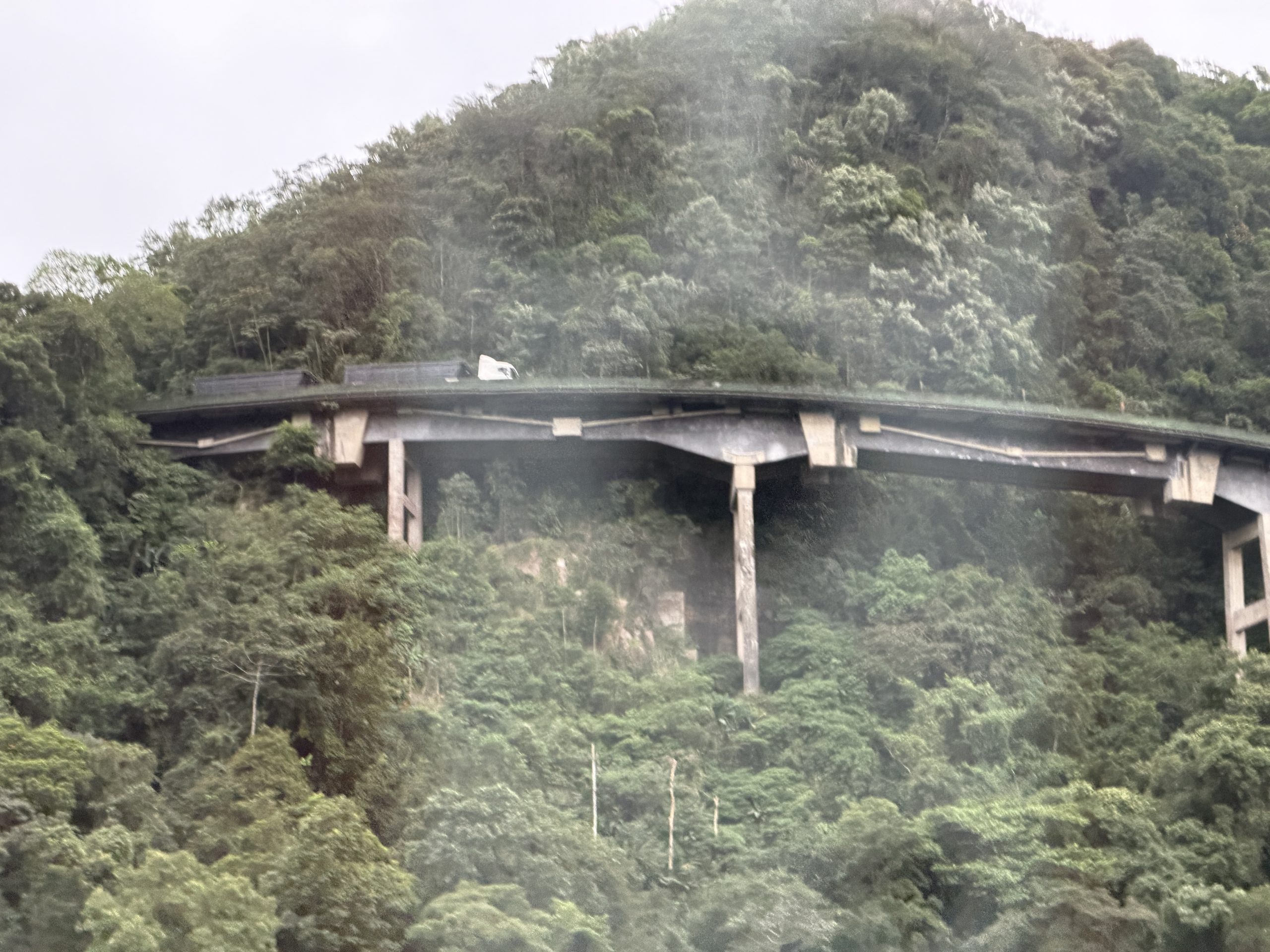
The drive from São Paulo down to the port of Santos is an experience of its own. Elevated motorways carry the trucks through steep mountain terrain, one level stacked above the other. It looks like a film set – or another planet.
Santos
Inspected piece by piece
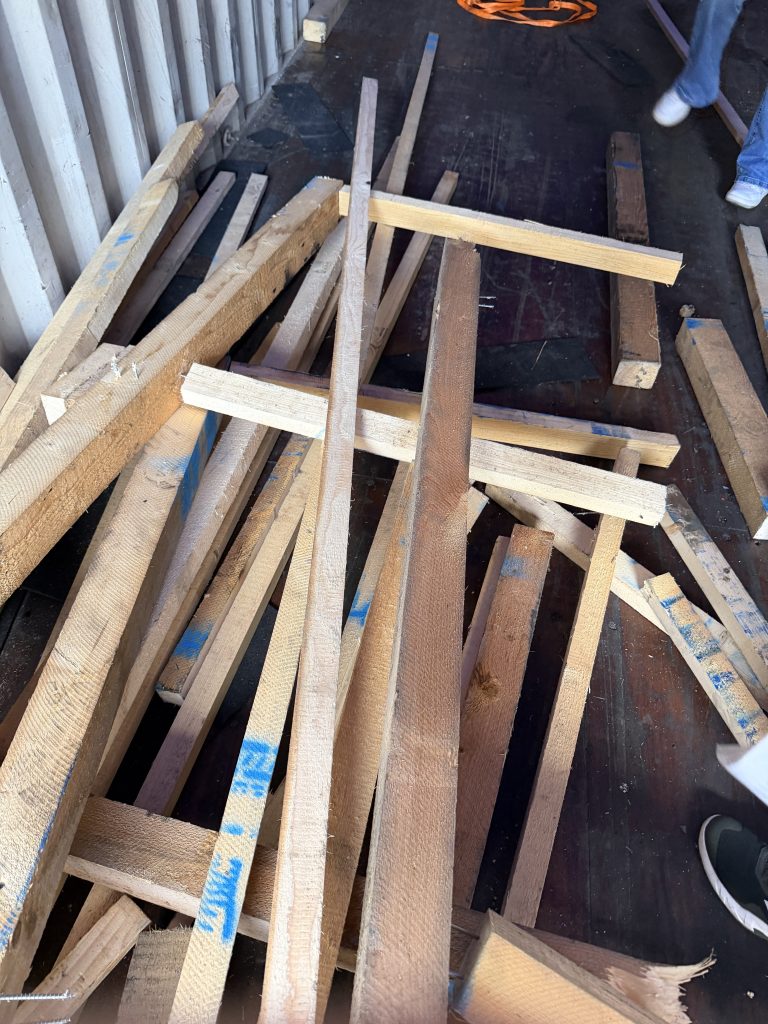
In Santos, Brazilian authorities inspected the shipment and initially questioned whether the wood used for packing met import requirements. We had paid particular attention to exactly this point before shipping, because wood packaging is a classic stumbling block in international freight.
It still triggered an additional inspection. The coaster was unloaded from the container and every single piece of wood was separated and examined. The result: everything was in order. The process cost three days.
Compliant packaging is necessary, but it does not guarantee a smooth inspection.
05 · The build
Four days from arrival to first ride
From Santos, the coaster travelled inland to Campos do Jordão. There, we assembled and commissioned it in about four days.
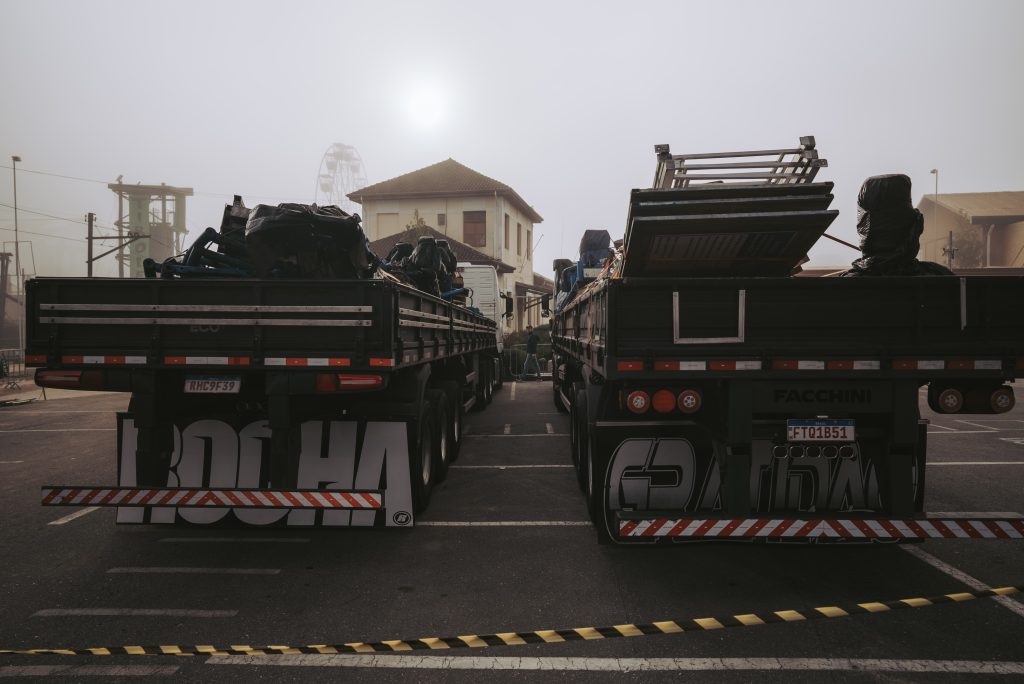
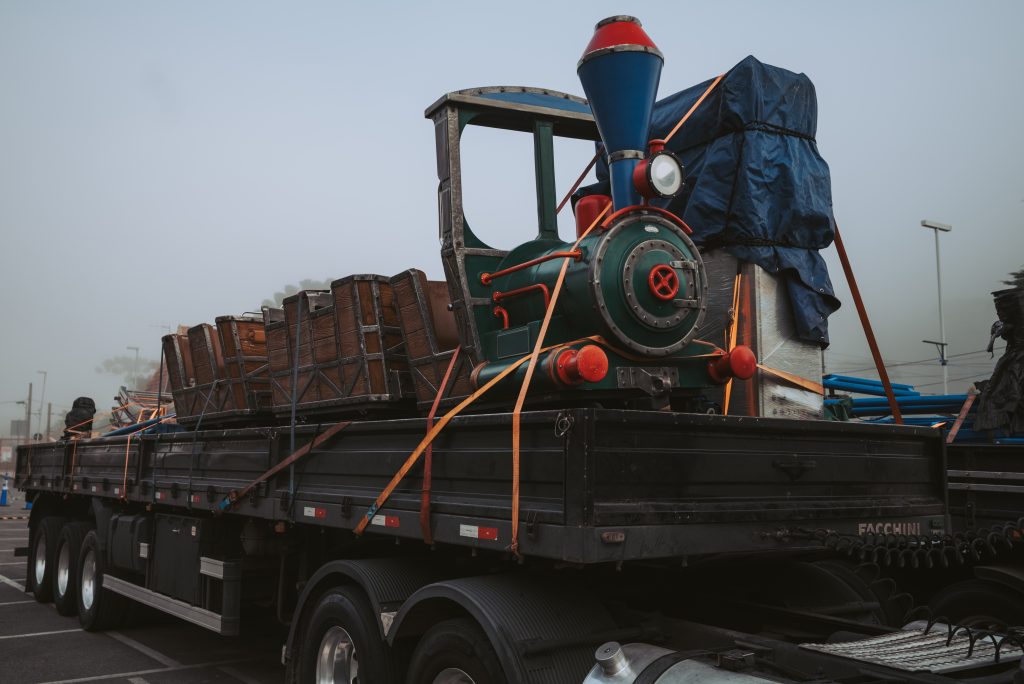
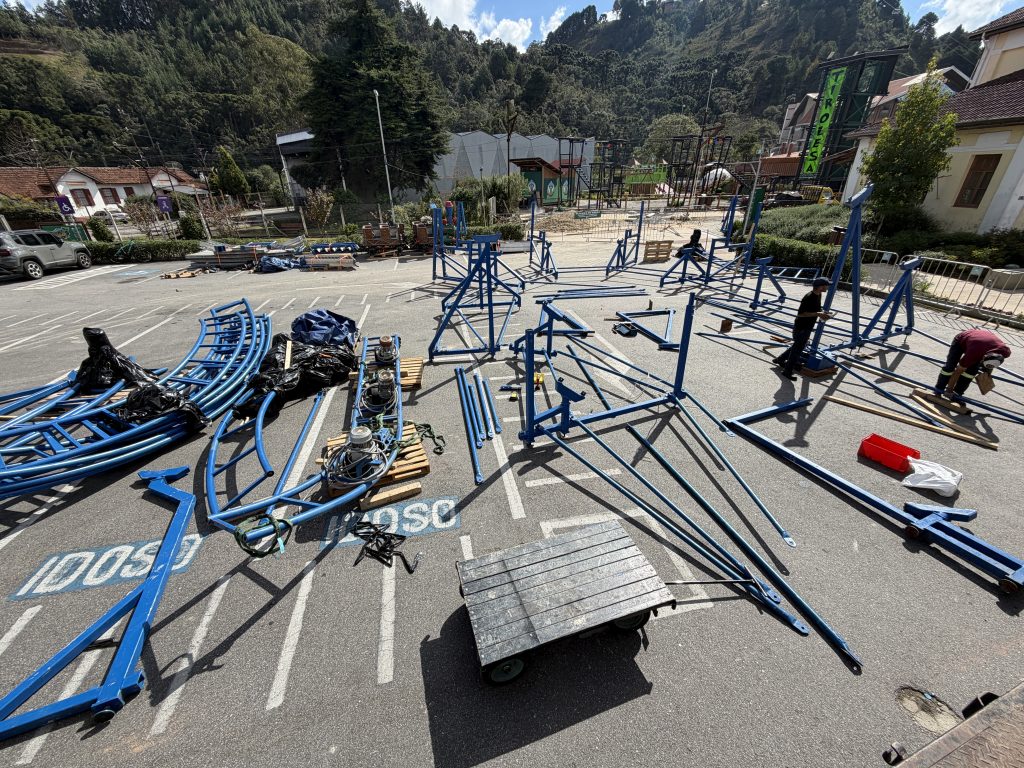
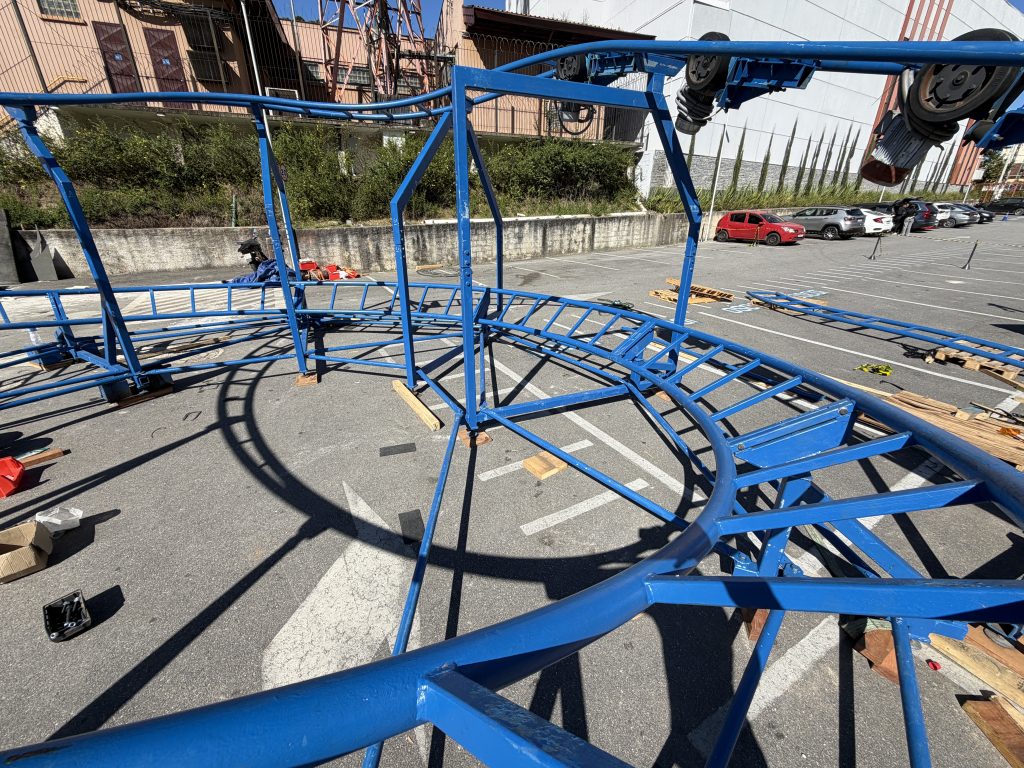
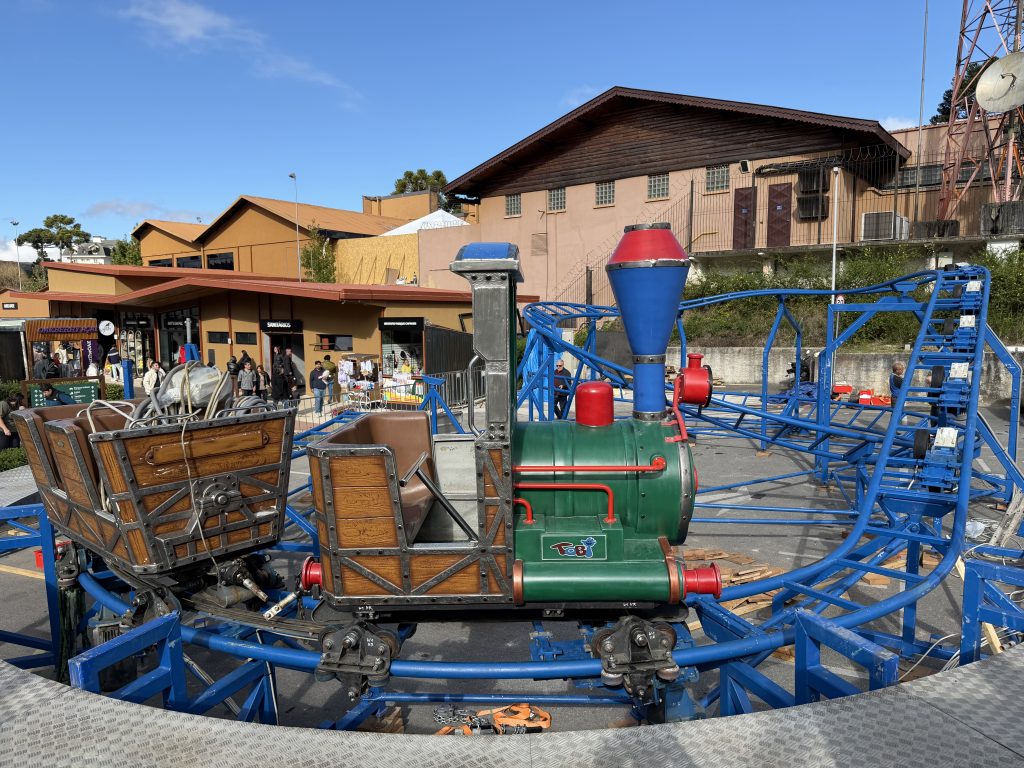
None of this would have been possible without Felix, my business partner in Brazil, whom I have known for around ten years. Together with our crew we worked late into the night.
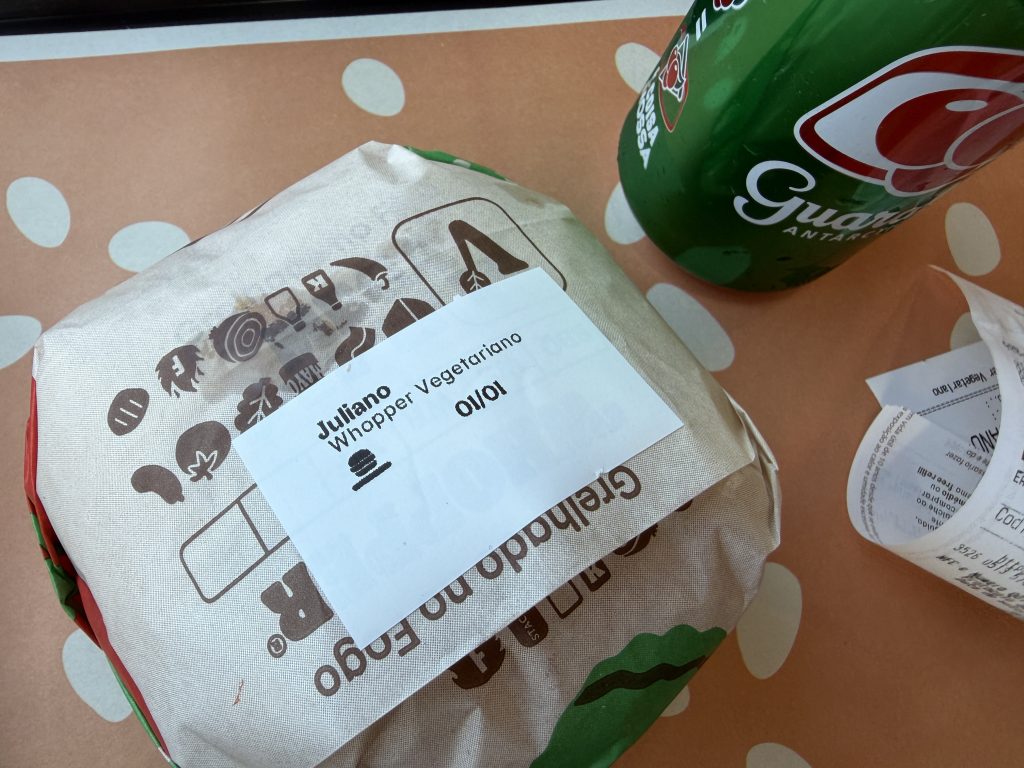
My fuel during the day was a typical açaí bowl from the stand next door – fast, filling, and I could keep working with it in my hand. I ate one practically every day.
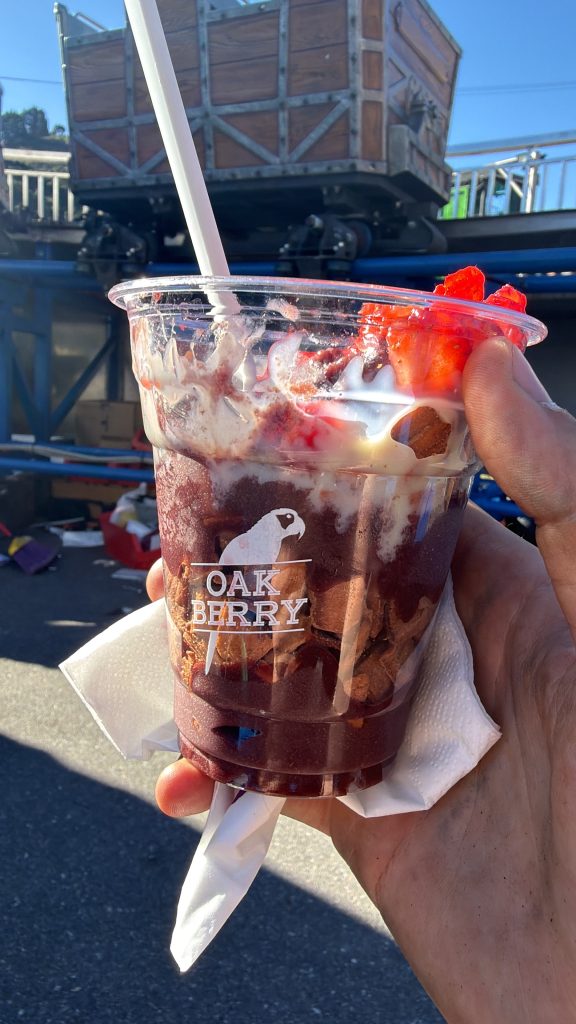
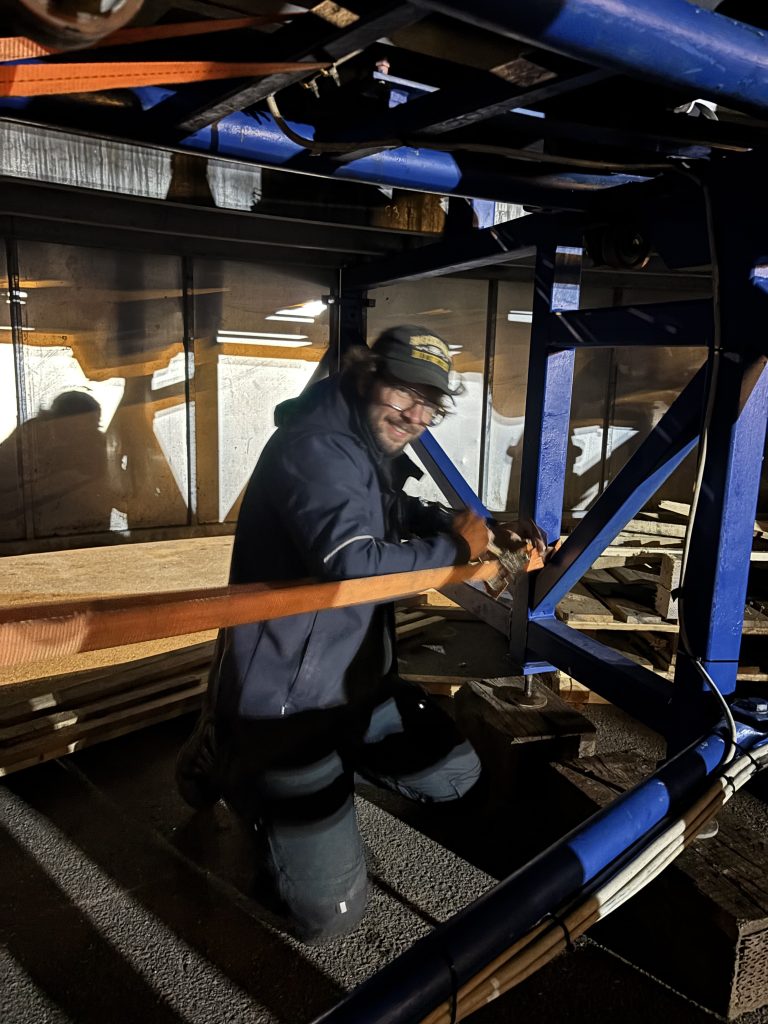
06 · The repair
Repairs against the clock
Not everything went perfectly.
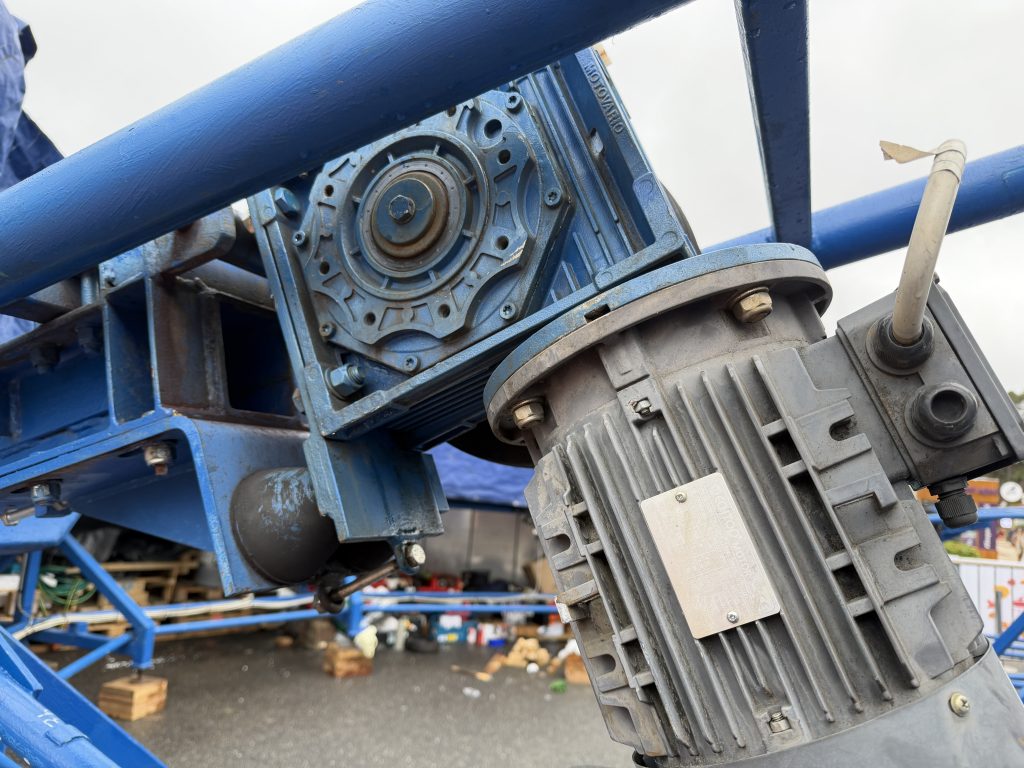
The cracked gearbox sat at the very top of the lift. It carried the greatest load from the train, which probably caused the crack we had noticed in Germany. We replaced it on site in Campos do Jordão – a lot of extra work in a schedule that had no slack.
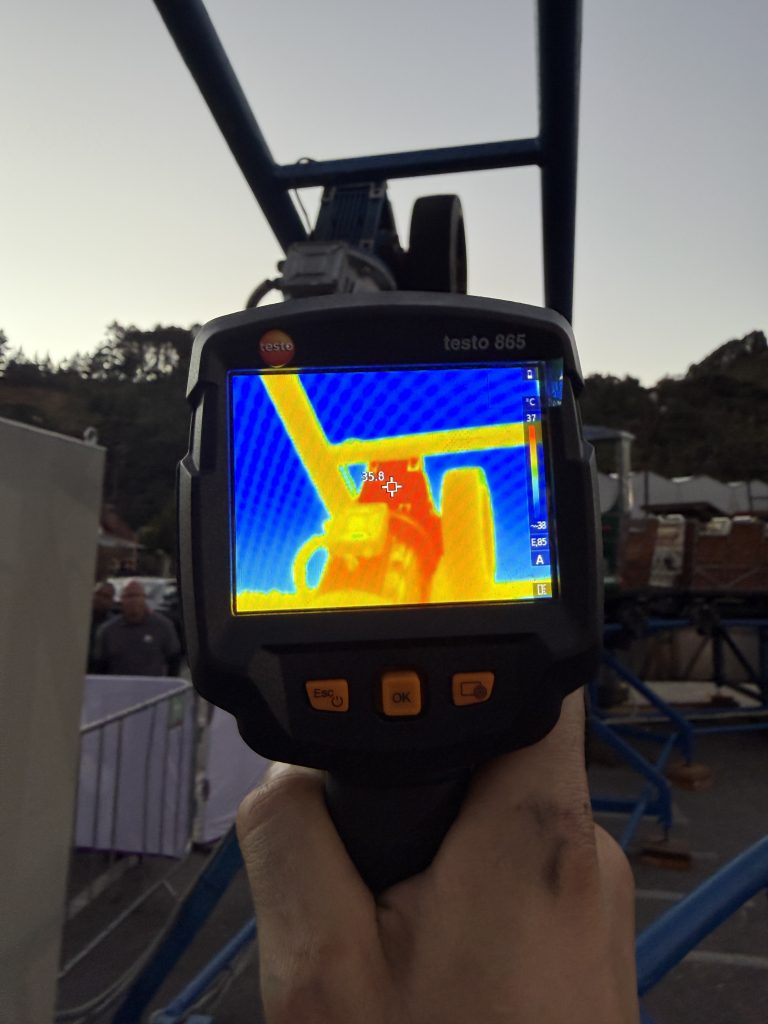
A second gearbox gave us a different worry: it might overheat. So we ran the ride and checked its temperature constantly with a thermal imaging camera. The readings told us when to add extra breaks or adjust the operating cycle for the moment.
That way we could keep the ride running under control, without risking damage to a second gearbox.
You will find things you did not expect. What matters is finding them early, handling them cleanly and having the experience to fix them on site.
07 · The result
Just in time for the season
The theming came with the ride and was adapted to its new home. We also added a water fountain to the layout. Because the train runs several laps, the fountain gives each lap a different rhythm and keeps the ride varied.
The ride opened on 6 June 2026, just in time for the season. Guests love it. It offers a gentle ride, yet the drop from three and a half metres delivers a genuine roller coaster feeling, and the curve adds a short burst of speed. It is the perfect first coaster for the park’s smallest guests – the riders who will be queuing for the big coasters a few years from now.
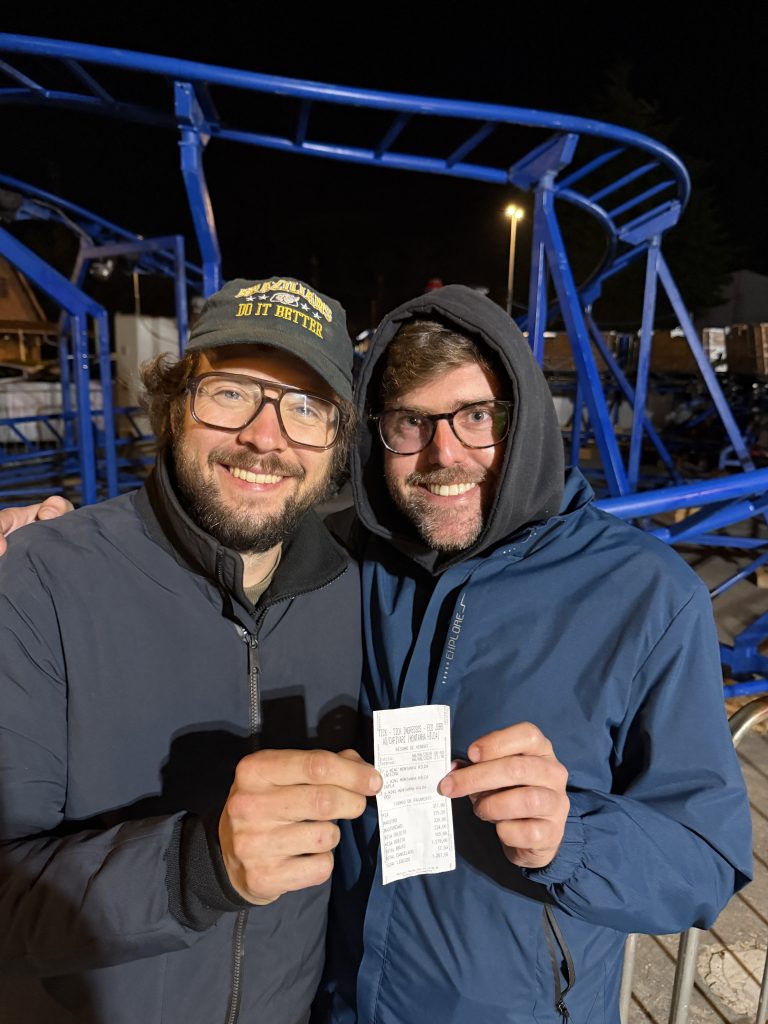
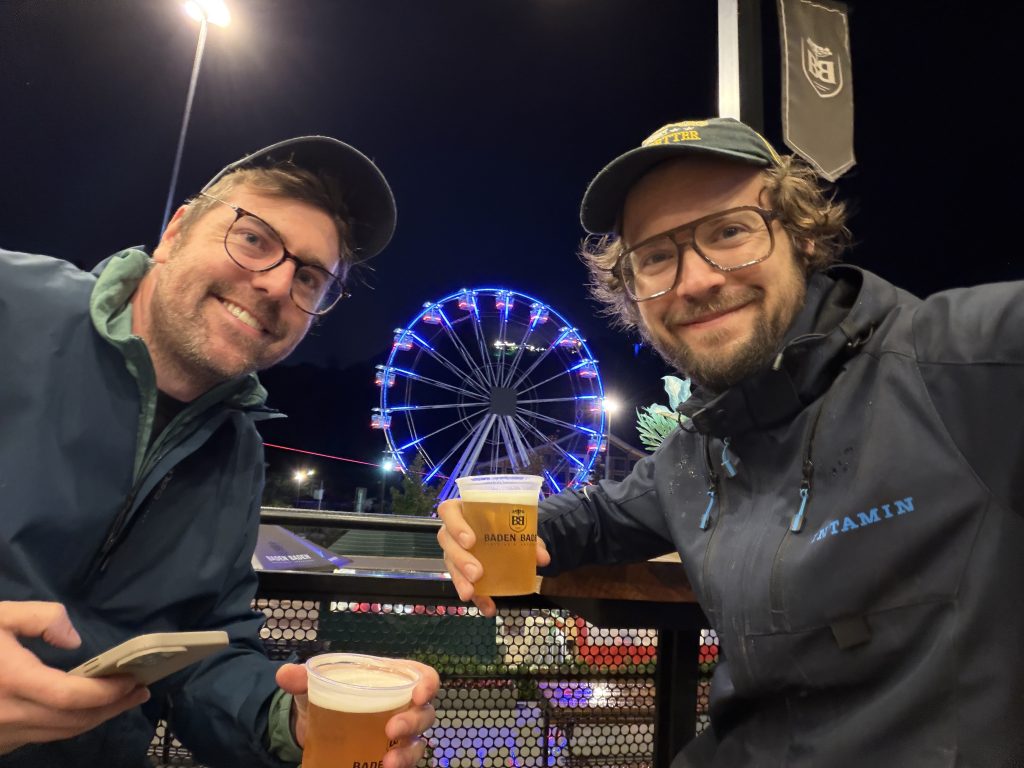
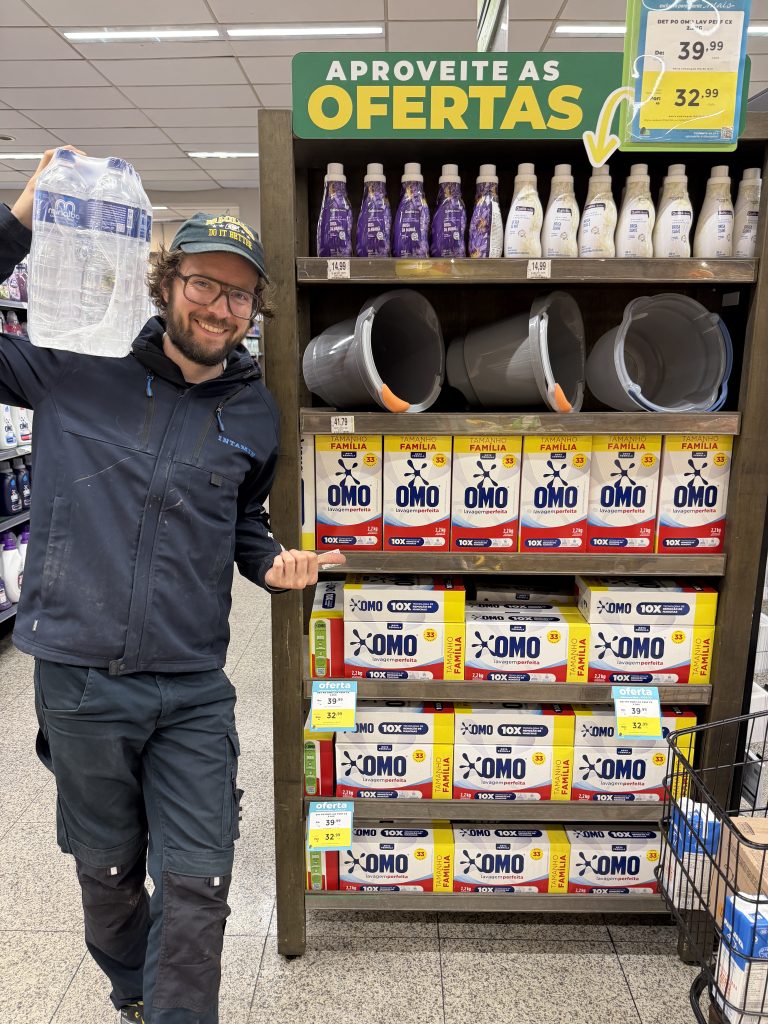
One of my favourite photos from the project shows Felix and me holding our very first takings. After weeks of costs, deadlines and worry, it was the moment the project became real.
08 · The market
What buying my own coaster taught me about the used-ride market
Trading used rides has become an important part of my business. Buying a coaster for my own project changed how I see that market.
Sitting on the buyer’s side of the table, with a hard deadline and my own money at stake, I understood much more directly what buyers need:
- Clarity early Honest information about condition, documentation and history before the deal, not after.
- A seller who responds fast With a tight timeline, every day of waiting is a day lost on site.
- A realistic plan for dismantling and transport The price of a ride is only part of the cost. Logistics decide whether a project works.
- Someone who has done it before Customs, packaging and inspections are where inexperienced projects lose weeks.
Commissioning in Brazil went almost without a hitch, too. My biggest worry had been the switch from 50 Hz to Brazil’s 60 Hz grid. In the end, it caused no problems at all.
A well-built ride, properly maintained, can travel much further than many buyers expect.
09 · Hilda
More to come
The partnership with Parque Capivari continues. Next, we are adding further games. For the coming summer season, two more rides will join the park.
Buying or selling a used ride, or moving one across borders? I know both sides of the table – and how to keep a project on schedule. Get in touch
Sources
- RCDB – Blombini Express – I.E. Park Mini OTTO, relocations Tobiland, Lollihop, Blombergbahn, Parque Capivari
- coaster.cloud – Blombini-Express – opened at the Blomberg under this name in 2014
- Coasterfriends – Blombergbahn – at Blomberg since 2014, previously Lollihop Munich
- Freizeitparkweb forum – Tobiland – indoor park in Cologne-Godorf, opened 2003
- travel.com.br – Campos do Jordão – 1,628 m, Serra da Mantiqueira
- Diário do Turismo – Parque Capivari – free entry, only rides are paid
- RCDB – Trenó, Parque Capivari – the park’s alpine coaster
- Esse Mundo é Nosso – When to visit Campos do Jordão – high season June to August, July busiest
Wiener Looping
All-out on red
The Wiener Looping at Vienna’s Prater is more than a new roller coaster.
It is a strategic statement and smart investment decisions.
By Julian Omonsky · Vienna, Austria
More than 40 roller coasters have operated in Vienna’s Prater, yet none became a permanent modern flagship. The Wiener Looping changes that. It shows how a family business, a clear brief and an integrated design process can turn a difficult site into a long-term asset.
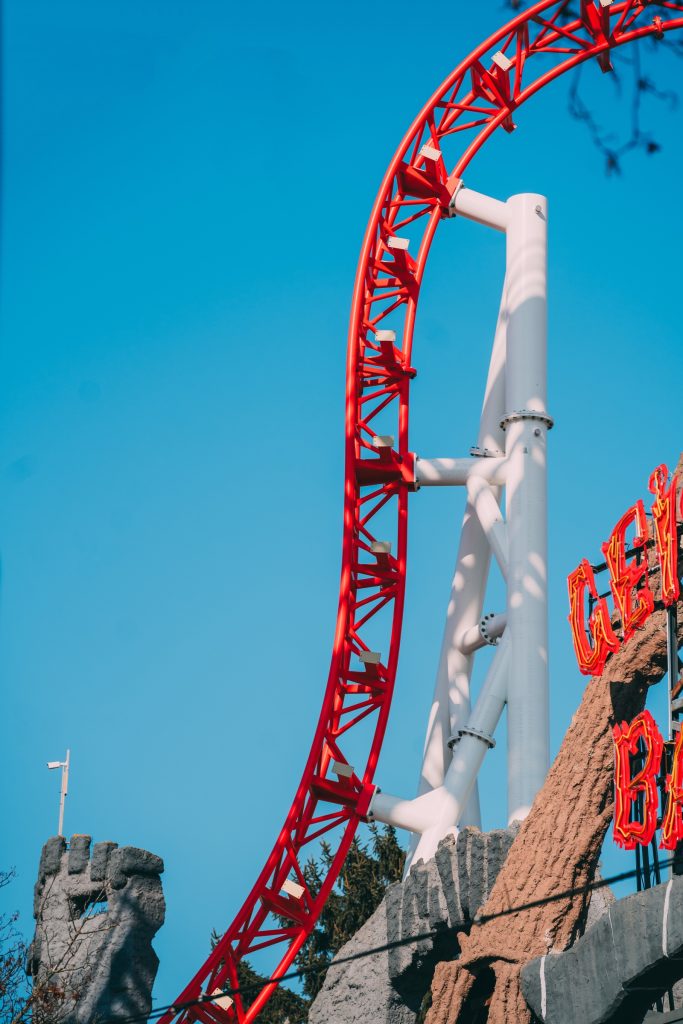
When a family-run business in the Prater commits to a looping coaster with a 92-degree drop, it is not a cautious investment. It is a bet on red: one family, one plot, one ride that has to hold its own against the flagship coasters of major theme parks. The Wiener Looping opened on 23 May 2025.
01
A heritage park with a development problem
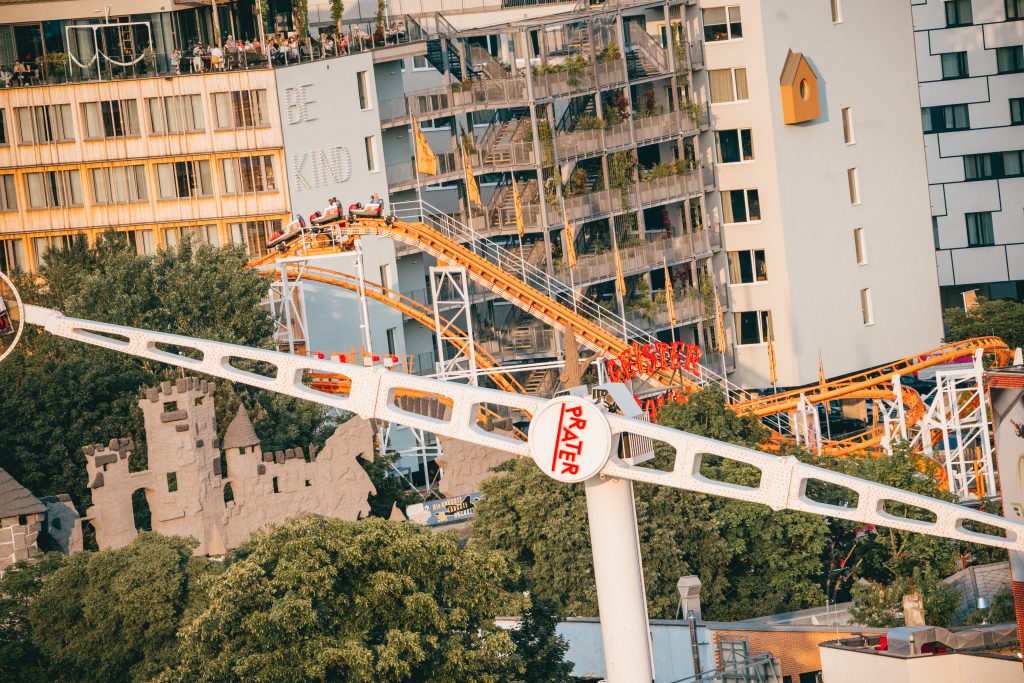
The Prater is one of Europe’s oldest amusement destinations. It dates back to the 18th century and welcomes millions of visitors every year. Unlike a master-planned theme park, it has grown organically, attraction by attraction, run by independent families over generations.
That structure gives the Prater its identity. It also makes large investments difficult. There is no central owner, no master plan and no shared budget. Every major ride is a private risk taken by one business on one plot. That is the main reason why, despite its long coaster history, the Prater never had a permanent modern flagship coaster until now.
02
The brief: bring the back of the Prater back to life
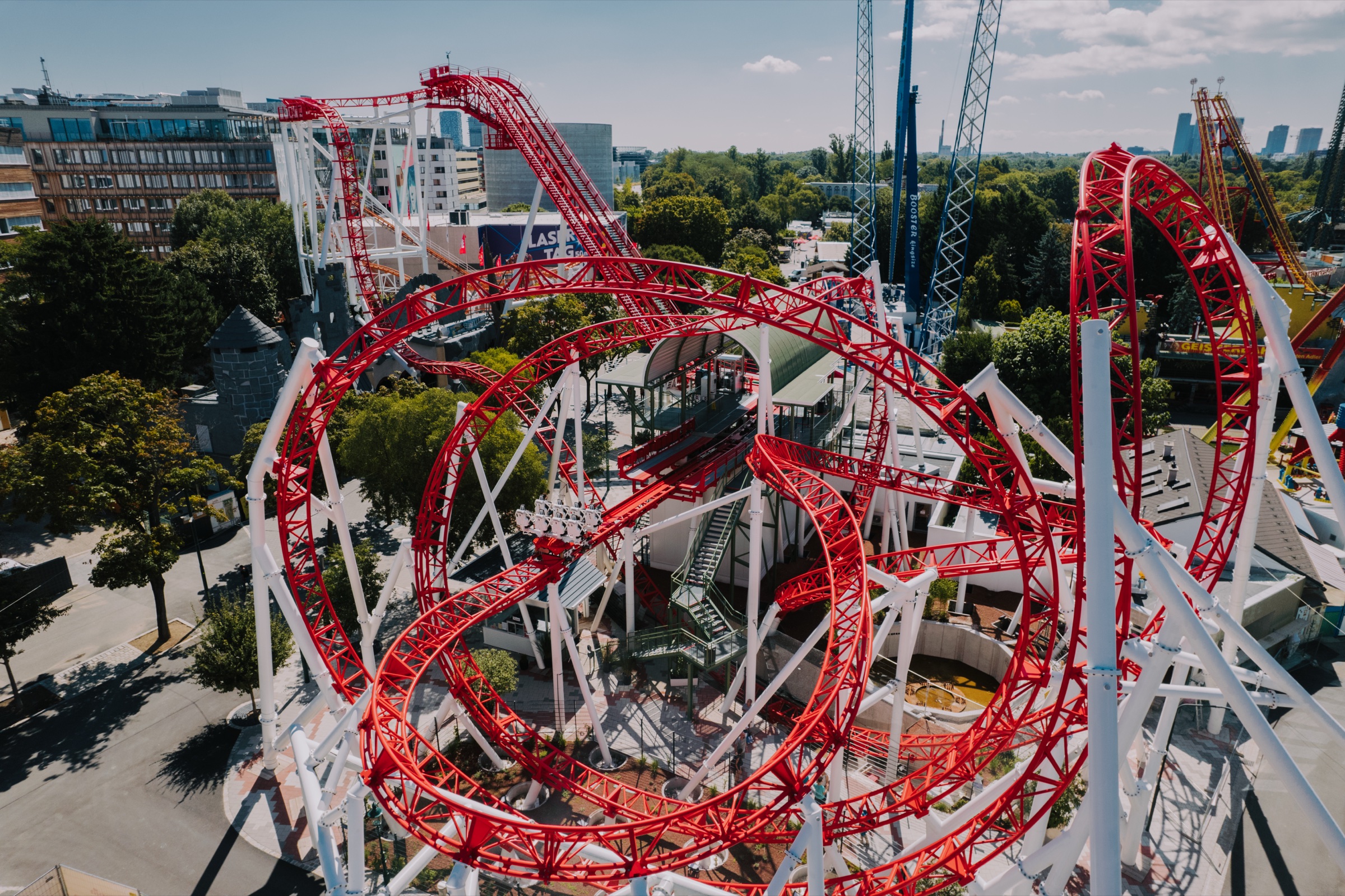
The project had two goals from the start. First, revitalise a quieter rear section of the park around the ghost train. Second, generate additional revenue for the neighbouring attractions, many of which are run by the same family.
The initiative came from Stefan Sittler-Koidl. His father-in-law had planned a coaster at the Prater back in 1982: the original Wiener Looping, which never opened to the public because of noise complaints from residents around the park. Stefan proposed developing the area and continuing that legacy, and the new ride carries its predecessor’s name.
03 · The role
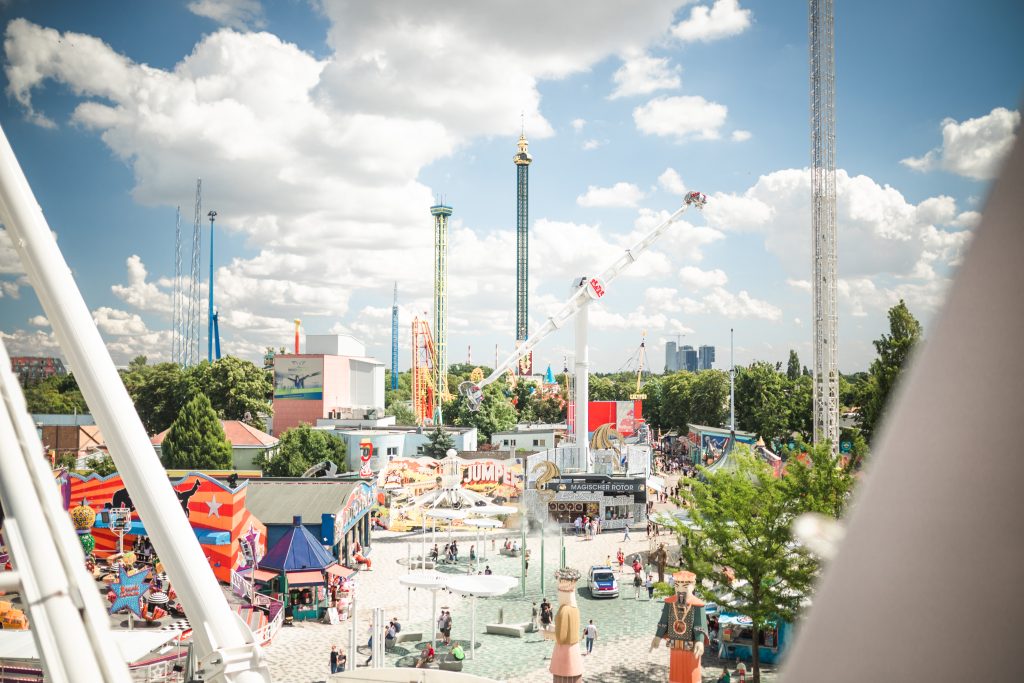
My role: the link between operator, strategy and manufacturer
Independent operators rarely have an in-house design team. Manufacturers, in turn, design around their own products.
In my experience, the gap between what an operator wants and what ends up on the order form is where much of a project’s value is lost.
My job on the Wiener Looping was to close that gap, from the first analysis to opening day.
- Strategy Analysing the existing attraction portfolio and defining the right ride type for location, audience and budget.
- Design Turning the operator’s vision into a layout, ride elements and an overall character.
- Representation Making sure the operator’s priorities held in every discussion and decision with the manufacturer.
- Execution Overseeing the project through manufacturer coordination, construction, testing and opening.
04 · The client
Vision meets structure
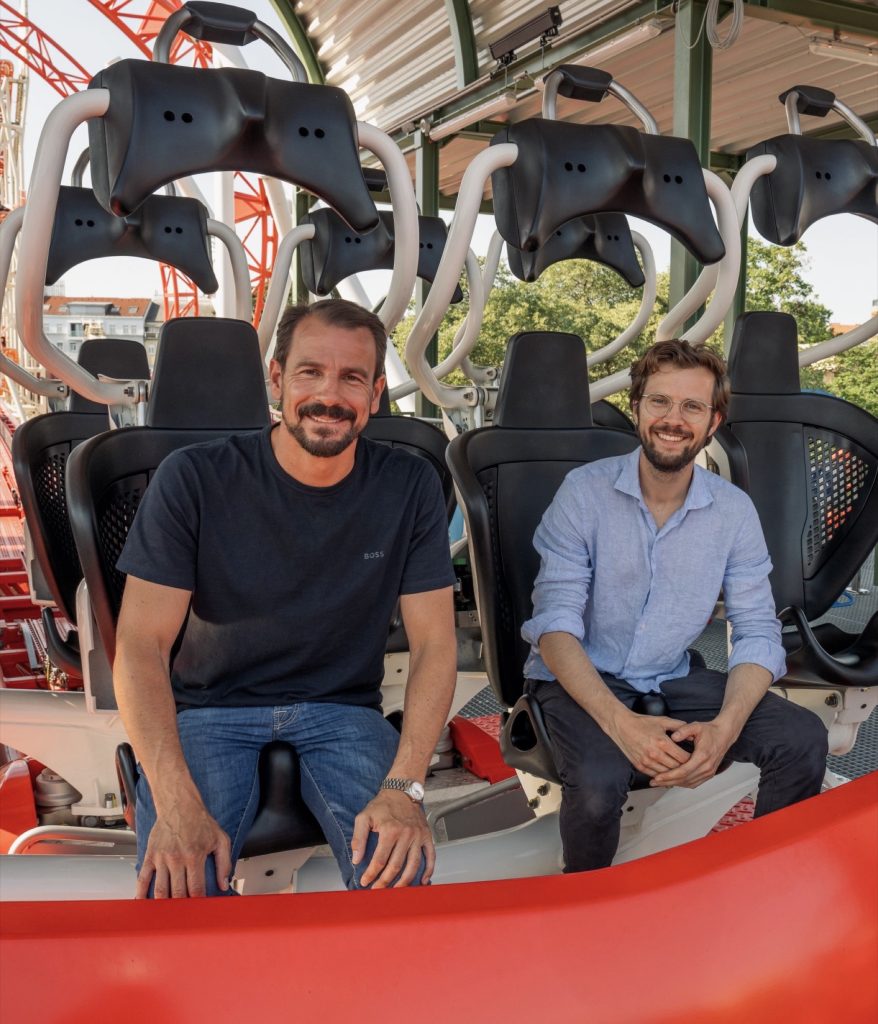
Stefan Sittler-Koidl, owner and operator of the Wiener Looping, arrived with a clear picture: what he loved about roller coasters, what he wanted to avoid, and what kind of emotional experience the ride should deliver.
My task was to structure that vision, test it against the site and the budget, and translate it into a design that could be built.
That trust made bold decisions possible. A 92-degree drop, a track that crosses a public street and a loop that sets new boundaries are not choices an operator signs off on without confidence in the process behind them.
I laid all my ideas, preferences, and also my no-gos on the table. What emerged is not a standard ride, but exactly the roller coaster I wanted for this location.
Stefan Sittler-Koidl, Owner & Operator
05
The loop as a brand
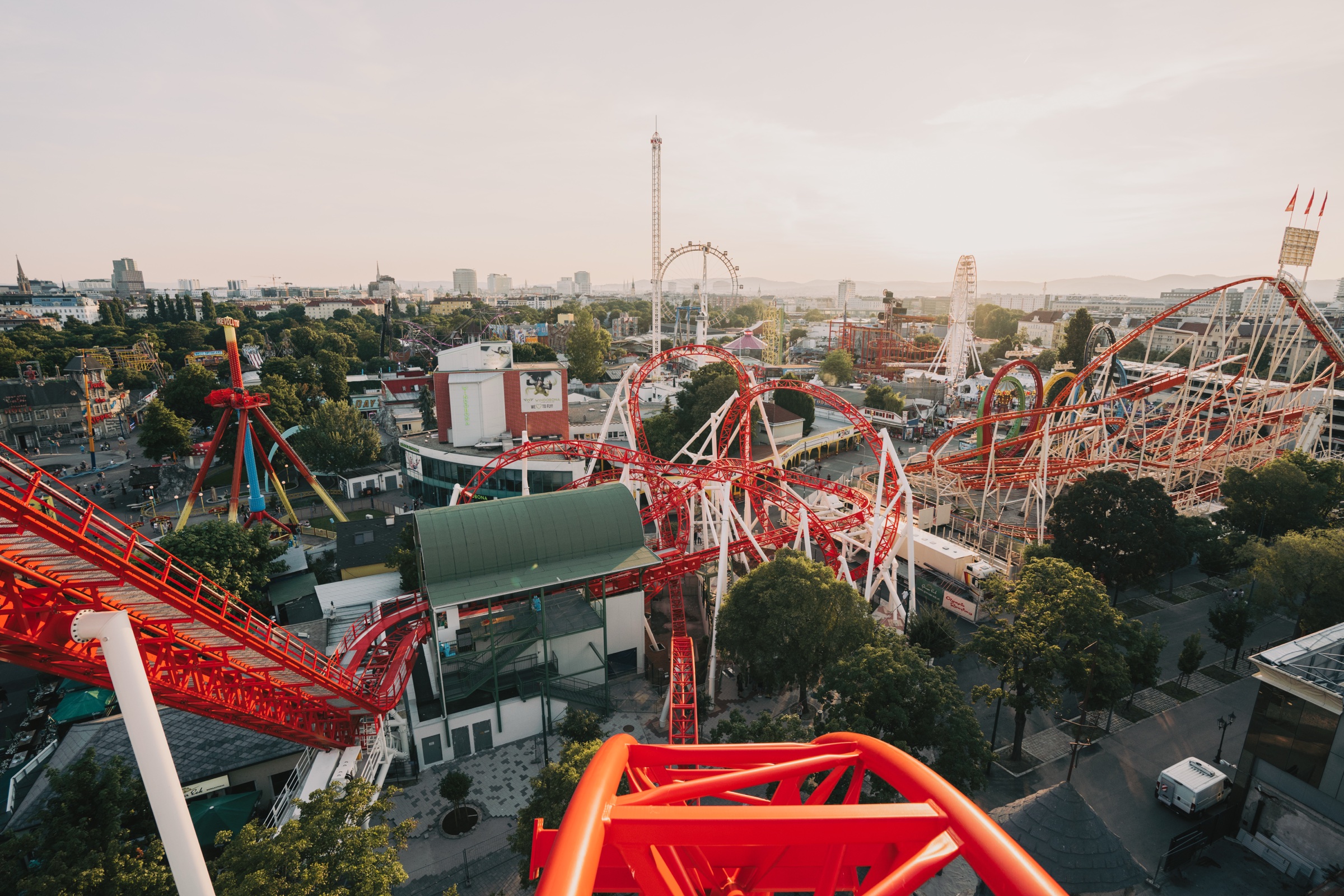
With the name settled, the centrepiece of the layout was settled too. Modern calculation methods allow manoeuvres that were impossible when the first modern vertical loop opened in 1976, on the Great American Revolution at Six Flags Magic Mountain. Our aim was a loop that looks and feels unlike any standard element: its overhead section is stretched to almost three seconds of near-weightlessness, and its wide radius gives room for the final curve to run through its centre.
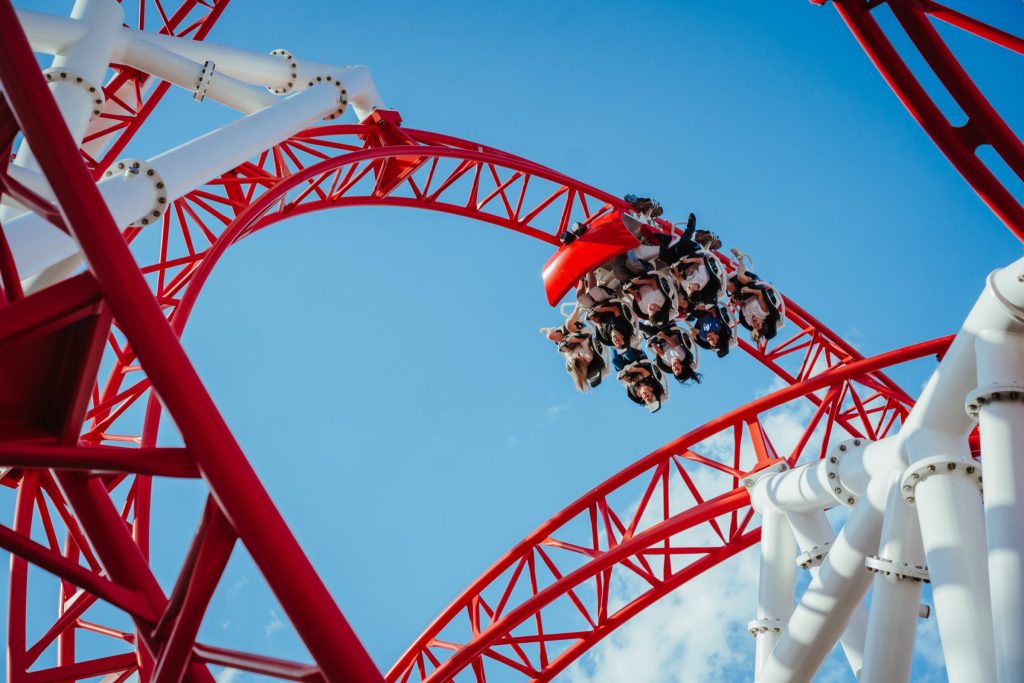
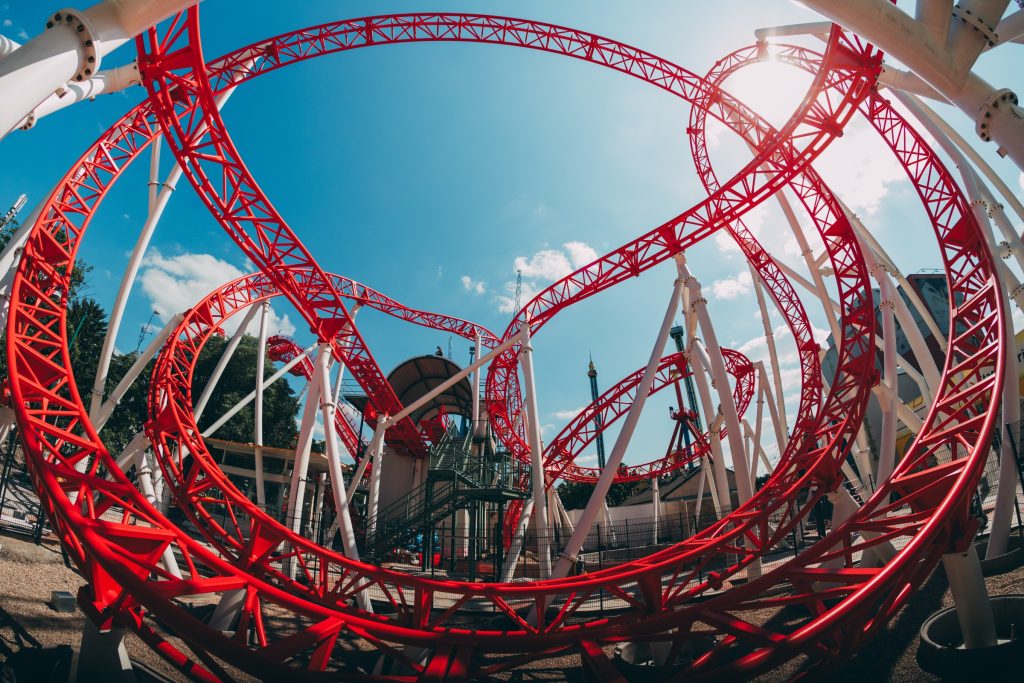
The loop does three jobs at once. It is the name-giving element of the ride, a visual landmark visible across the Prater, and a highlight that brings riders back for another go. How the site shaped this and every other element is described in Part 1, “A Bold Decision”.
- 31 mLift hill
- 92°First drop
- 82 km/hTop speed
- 3Inversions
- ~3 sUpside down in the loop
06
Designed for the long run
The Wiener Looping was planned as a long-term investment, not a one-season sensation.
- Visitor flow The ride pulls guests into a previously quiet part of the Prater and strengthens the businesses around it.
- Room to grow The helix was designed with a future expansion in mind, such as a planned observation tower.
- A second life built in The cars can be configured to ride backwards. That enables a relaunch later, with new marketing and minimal operational effort.
- Repeat riding Pacing and intensity are tuned to make guests want to ride again – essential in a pay-per-ride environment.
07
Five lessons for operators
The Wiener Looping is a Prater-specific project, but its logic travels.
- Let the business model pick the ride type. In pay-per-ride, constant visible motion sells tickets. Capacity alone does not.
- Treat the site’s constraints as the brief. The ghost train, the street and the irregular plot produced the ride’s best moments.
- Design the signature element first. A memorable element is ride experience and marketing in one.
- Build in a second life. Expansion space and cars that can run backwards let the ride return as something new years later, without buying a new one.
- Give the operator’s vision an advocate. Someone has to hold the operator’s priorities in every manufacturer meeting.
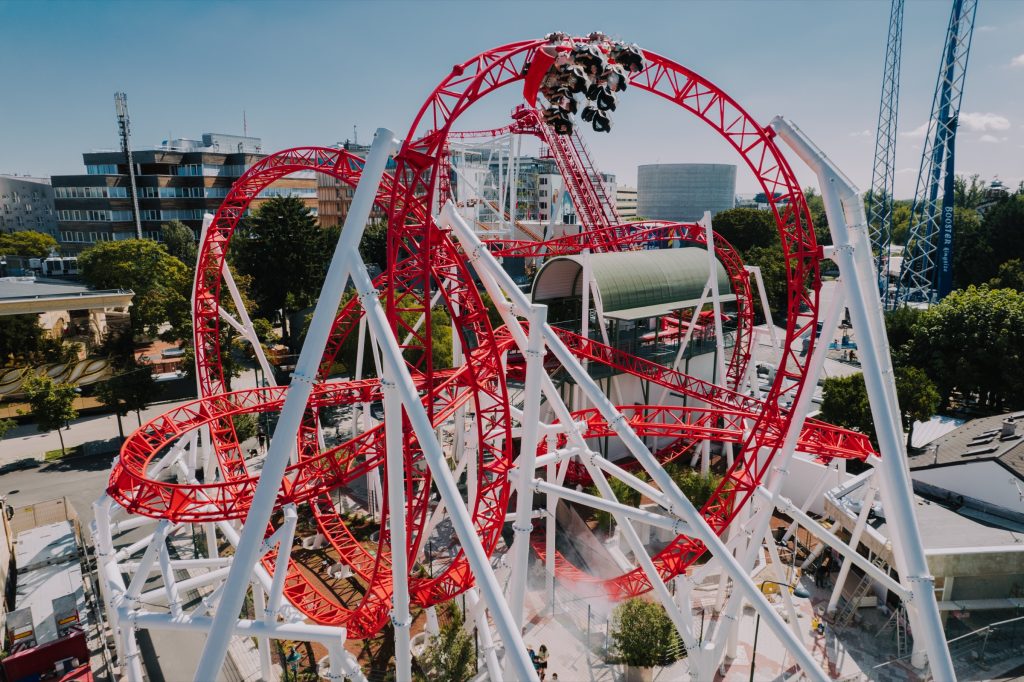
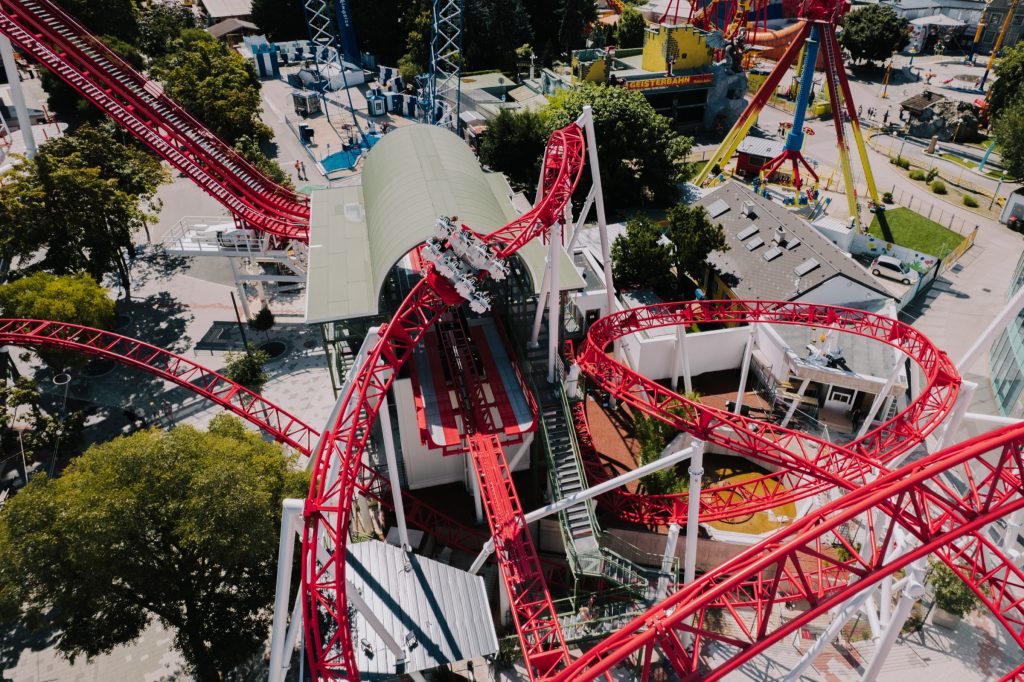
The Wiener Looping set the standard for how I work: guiding a vision from strategic concept through detailed planning and technical execution to operational alignment.
In upcoming articles I will look behind the scenes at construction, maintenance-friendly design and the decisions that never show up on a ride video.
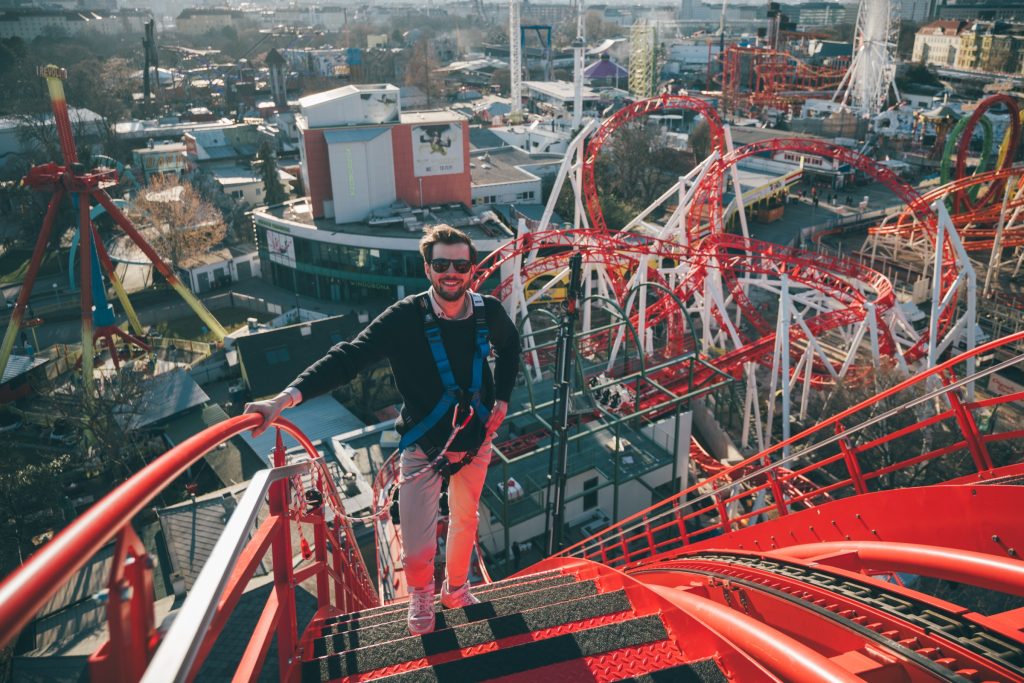
Evaluating a new attraction or repositioning an existing site? I am happy to discuss how a strategically designed ride can strengthen both guest experience and long-term business performance. Get in touch
Previously in this series A Bold Decision: how a difficult site shaped every element of the Wiener Looping
A bold decision
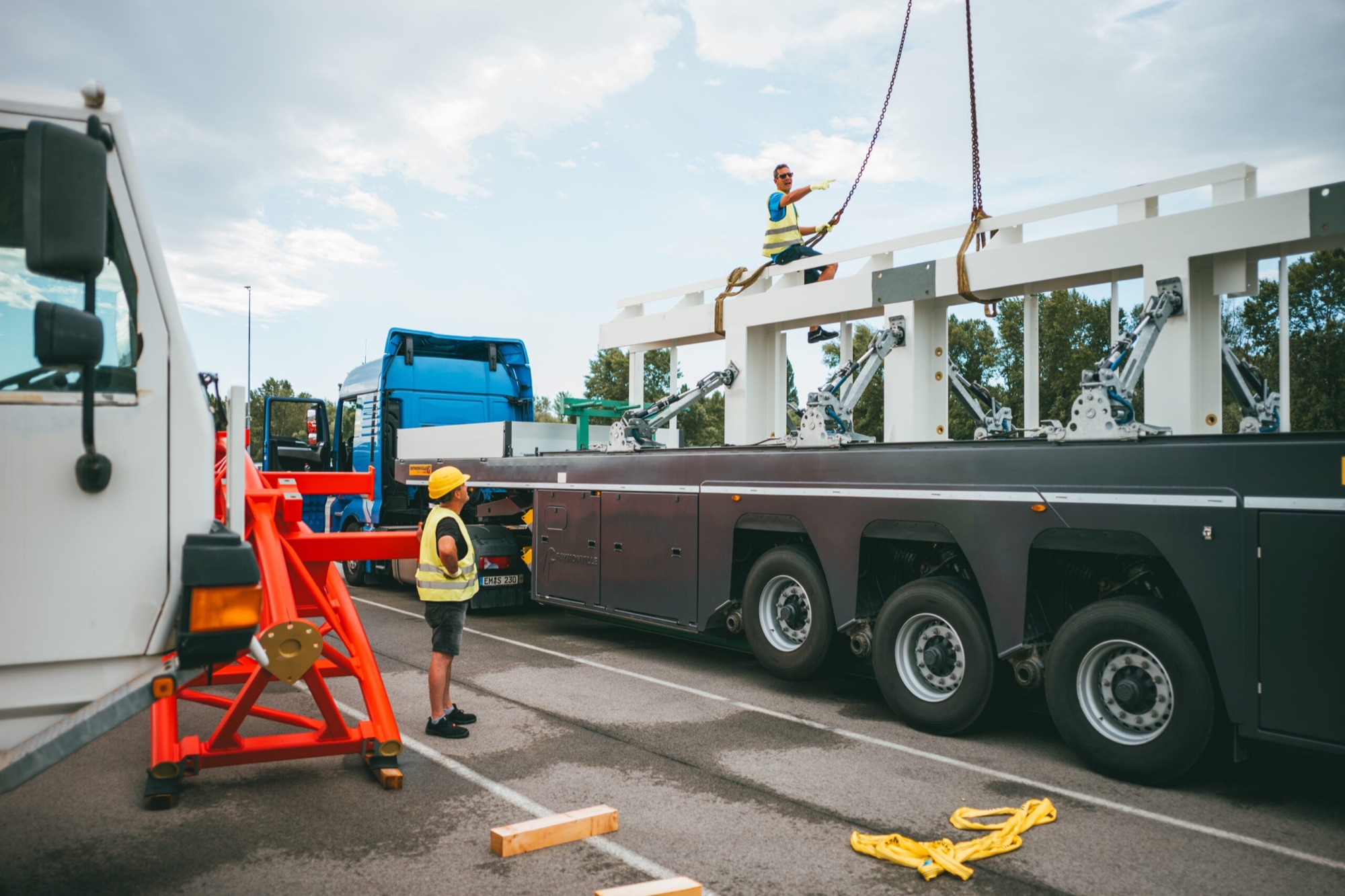
Bold.
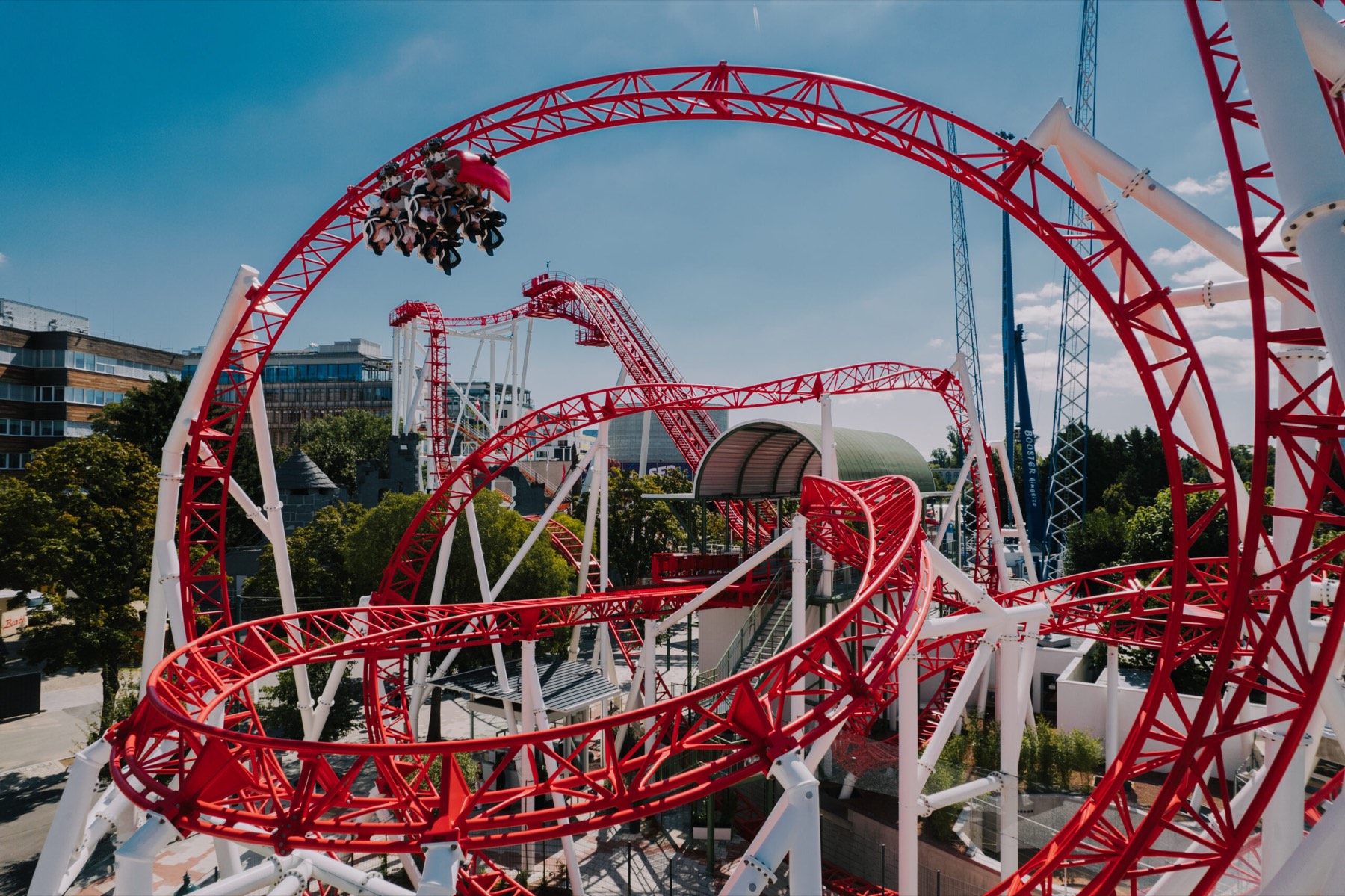
The Wiener Looping is one of the most spectacular rides at the Wiener Prater. With three inversions, a top speed of 82 km/h, several twists and turns and a beyond-vertical first drop, this roller coaster has become a new highlight in Vienna.
By Julian Omonsky · Vienna, Austria
A 92-degree first drop, a loop that holds riders upside down for almost three seconds, and a track that crosses a public street. Looking back at the planning phase, I explain how a difficult site shaped every element of the ride.
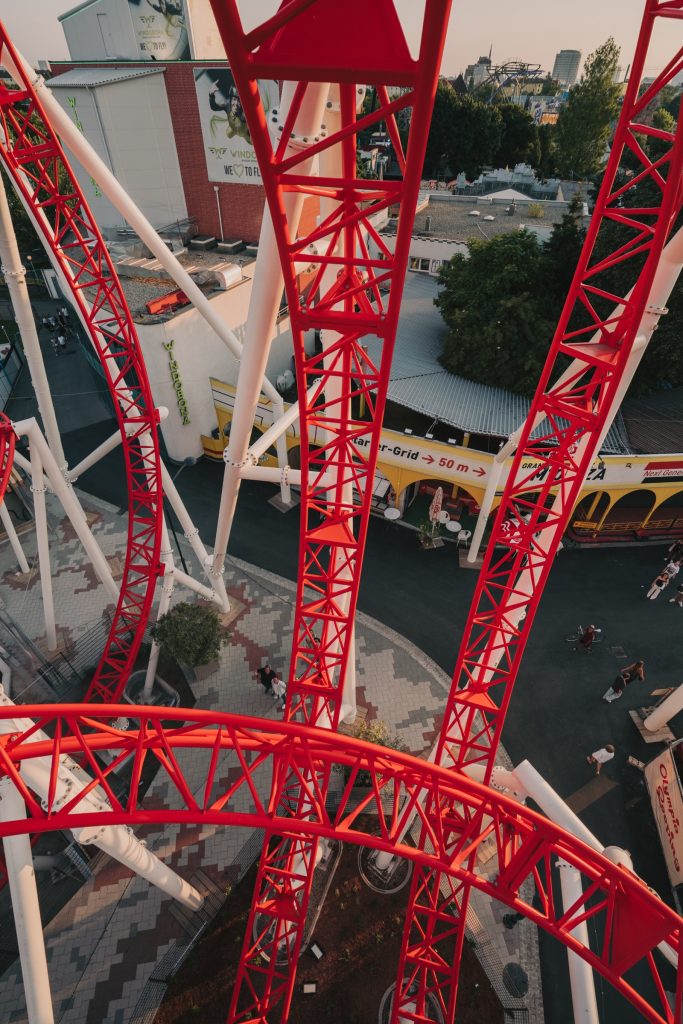
Most roller coasters begin on a blank sheet. When we started planning the Wiener Looping, we began with a ghost train that could not move, a public walkway that had to stay open, and a plot that had been divided, merged and rebuilt so often that it was barely suitable for a coaster at all.
The result is a layout that would make little sense anywhere else. And that is exactly why it works in the Prater.
01 · The business model
The business model
chooses the ride
In a gated theme park, guests pay once and ride as often as the queues allow. The Prater works differently. Every ride is paid for individually, and most attractions are run by independent, often family-owned businesses competing for the same passer-by. A ride has to sell itself from the walkway, every few seconds.
That settled the first decision before a single piece of track was drawn: no long trains. A conventional multi-car train spends a large share of each cycle parked in the station while it loads. Short single cars leave the station one after another and keep the ride in constant motion, and motion is what makes people stop, look up and reach for their wallet.
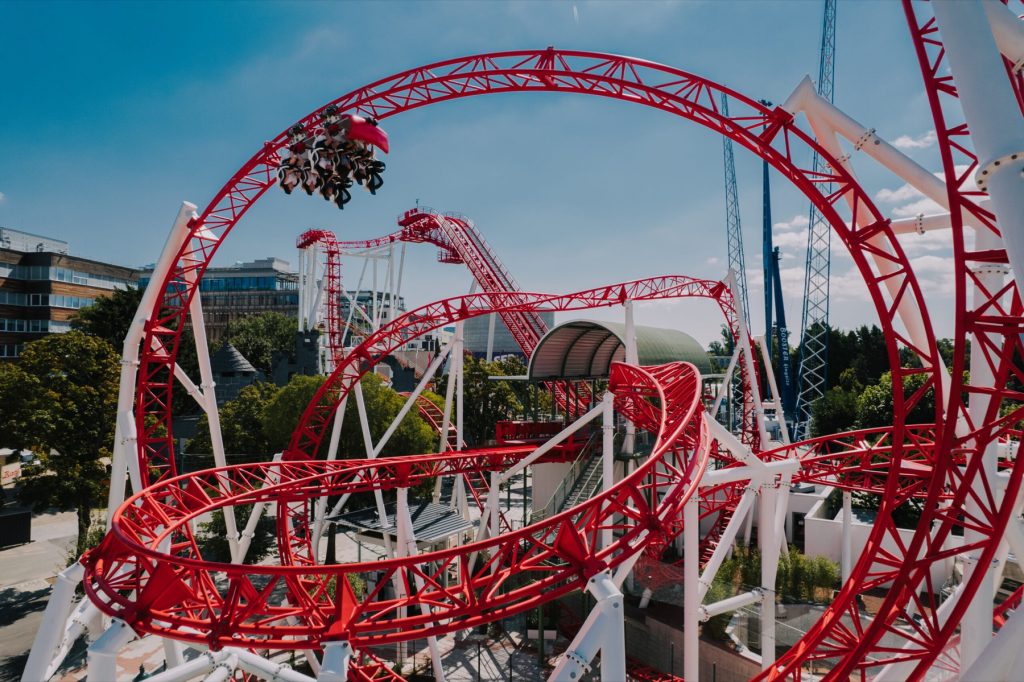
No movement, no screams.
No screams, no queue.
After comparing several manufacturers, we chose Mack Rides of Waldkirch, Germany, and its Big Dipper vehicle concept. Each car seats eight passengers, including outer seats positioned beyond the track, so riders on the edge have nothing but air beside them. This coaster type combines frequent dispatches, a compact footprint and a ride experience that stands out among dozens of competing rides.
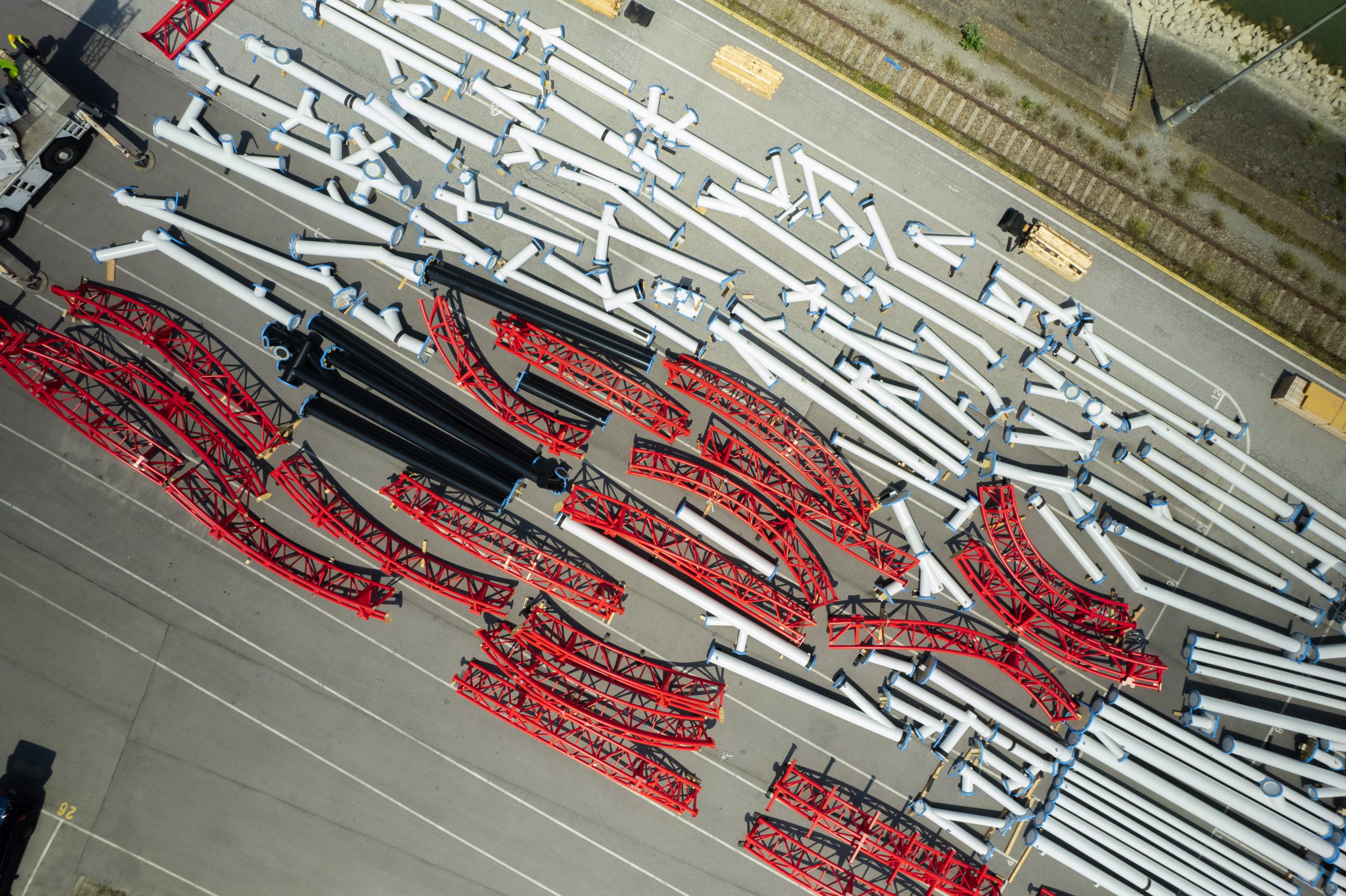
02 · The site
A plot with a past
Space is the Prater’s scarcest resource. Since reconstruction after 1945, almost every free square metre has been built on.
The Prater is divided into mostly rectangular plots, each run by a showman with one or more rides of their own. The Wiener Looping’s site is nothing like that.
Over the decades it has been subdivided, merged and redeveloped again and again. What remained was a plot that was hardly made for a roller coaster.
Instead of shrinking the ride to fit, we let the design reach beyond the plot’s boundaries. The track leaves the site in several places, crosses three public streets and ties a second plot into the layout.
Building over public ground on this scale had never been done in the Prater before, and it remains unique there. On paper the layout looks unusual. On site, it sits in its surroundings as if it had always been there.
The difficult site was never the obstacle.
It was the brief.
03 · The footprint
Where coasters waste space
Two elements are notoriously inefficient on a tight site: the lift hill and the final brake run. Both are usually long straight sections. Both take up a large share of the footprint, and neither adds a great deal to the ride experience.
On the Wiener Looping, both became tools. The lift hill leads away from the core of the site, freeing the centre for the elements guests actually see from the walkway.
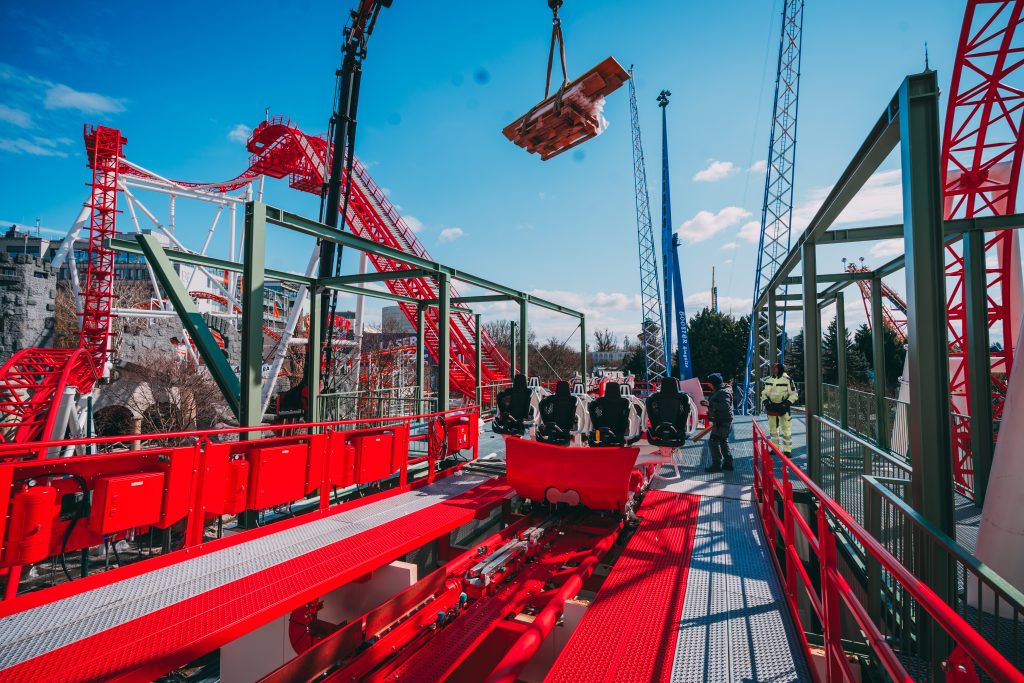
The final brake run sits deliberately high: the car arrives more slowly after climbing into it, needs a shorter braking distance and therefore less track and less ground.
04 · The ride
The ride, element by element
The car leaves the station in a left turn and climbs the lift hill to 31 metres. A panoramic curve at the top ends in a pause just before the first drop. It is a held moment with a view across Vienna and the Prater, and a deliberate build-up of tension.
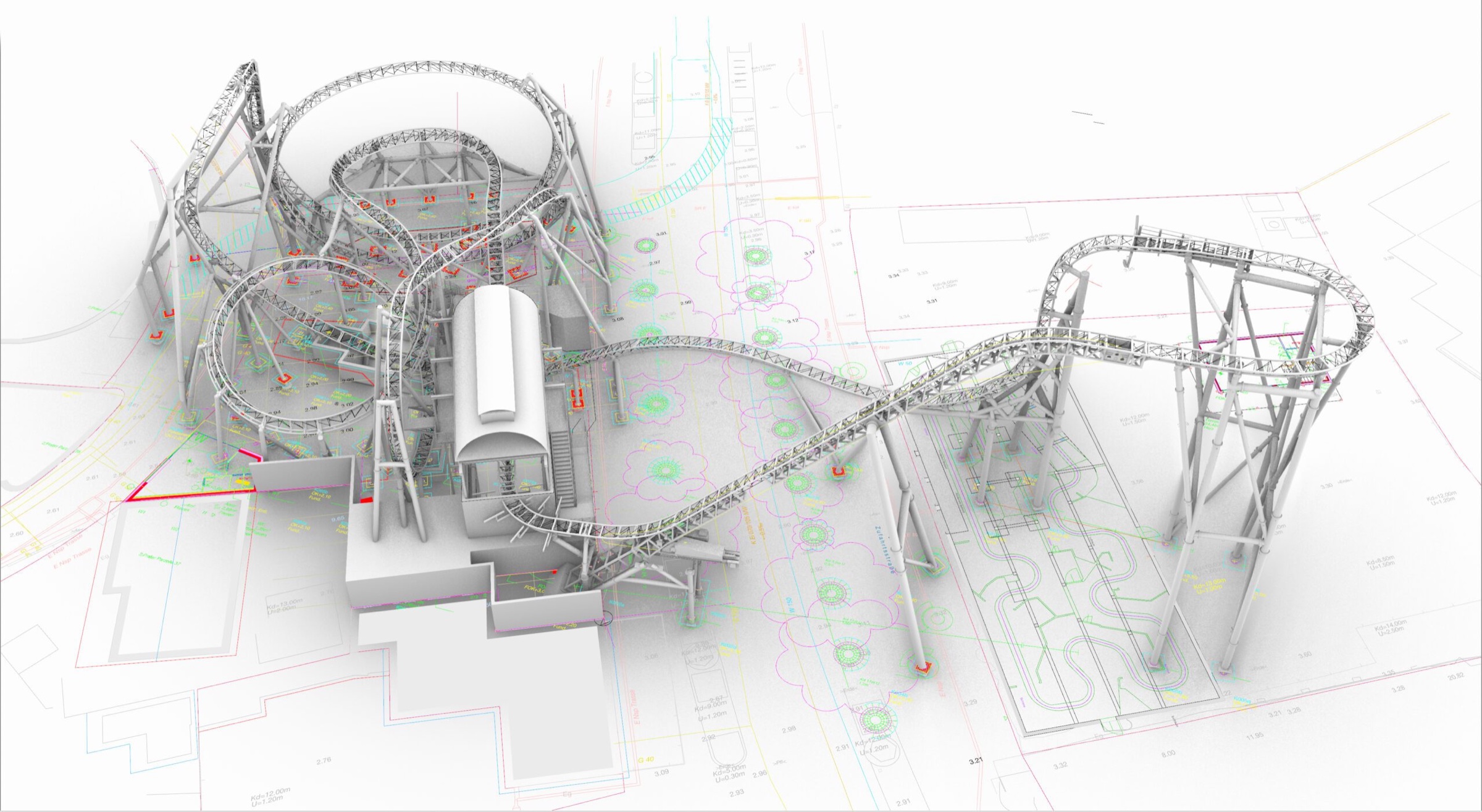
- A 92-degree double down The first drop is beyond vertical, at 92 degrees. Unlike most coasters, it does not run straight to the ground. It breaks into a double down: the steep drop is followed by a camelback that delivers the ejector airtime enthusiasts look for, before the track falls again. This was not a stylistic choice alone. Directly beneath the first drop stands an existing ghost train. The double down clears the building and adds a moment of airtime the ride would otherwise not have had.
- The Banana Roll Coming back towards the main plot, riders face the tangle of track ahead of them. At the lowest point of the circuit the car reaches its top speed of 82 km/h and rises into the Banana Roll. The element is related to an inverted top hat, but its apex is tilted inwards; from the side, the curved silhouette gives it its name. Its function is simple: it turns the car around before the plot runs out.
- A loop that refuses to be quick Then comes the element that gives the ride its name. A conventional loop has its tightest radius at the top, so riders pass the inversion in a fraction of a second. The Wiener Looping stretches the top instead. The overhead section is lengthened until riders hang upside down in near-weightlessness for almost three seconds. The large radius has a second benefit: it leaves room for the final curve to pass straight through the loop later on. Two elements, one footprint.
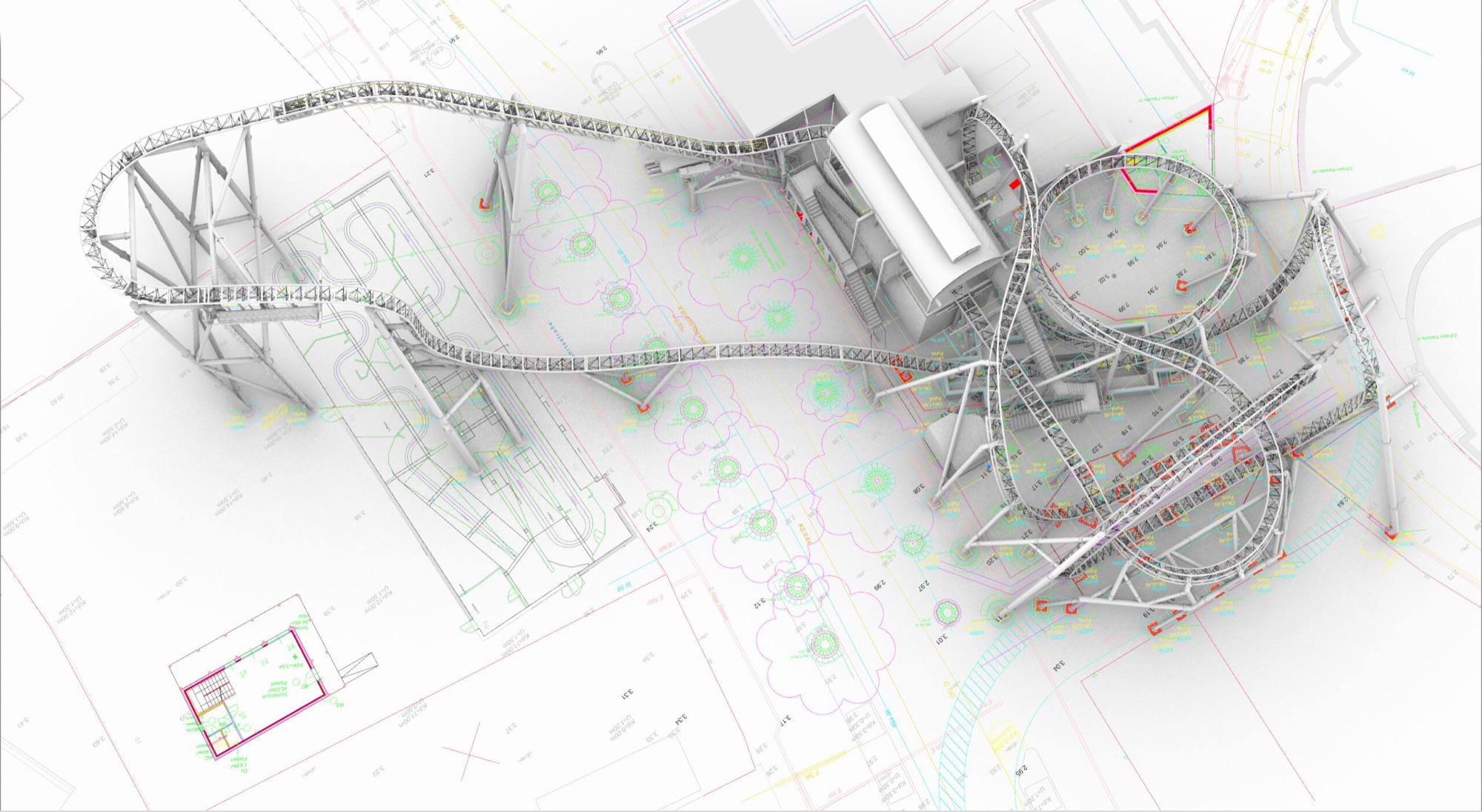
- The Monsieur-Sky-Roll The loop exit leads straight into the next transition. In a right turn the track climbs steeply, banks to 104 degrees, then rolls 284 degrees to the left and drops into a dive loop right next to the station. Where the loop floats, this element ejects: riders are lifted out of their seats mid-twist. What I had in mind was the sensation of a so-called non-inverting loop. The name came from the ride’s owner, Stefan Sittler-Koidl.
- Helix, twist and a final surprise After the dive loop comes an overbanked turn, a tribute to the original Wiener Looping, which feeds into a forceful helix. A twisted airtime hill at 12 metres leads into the final turn, which threads through the centre of the loop. Its exit holds one last surprise, inspired by Dæmonen at Tivoli Gardens in Copenhagen: instead of a final airtime hill before the brakes, the track snaps out of the banked turn into the straight in one fast twist, and the car shoots into the brake run.
05 · The finale
Time for a Brake
The final brake is rarely discussed. On most coasters, it is a functional afterthought at the end of the layout. On the Wiener Looping, it got the same attention as every other element.
The position: the final brake sits at the eye level of the guests waiting to board. They see the faces of riders who have just come back from their adventure – the laughter, the disbelief, the adrenaline. Their ticket is already bought, but nothing builds anticipation like that moment. Emotion becomes marketing, at no cost.
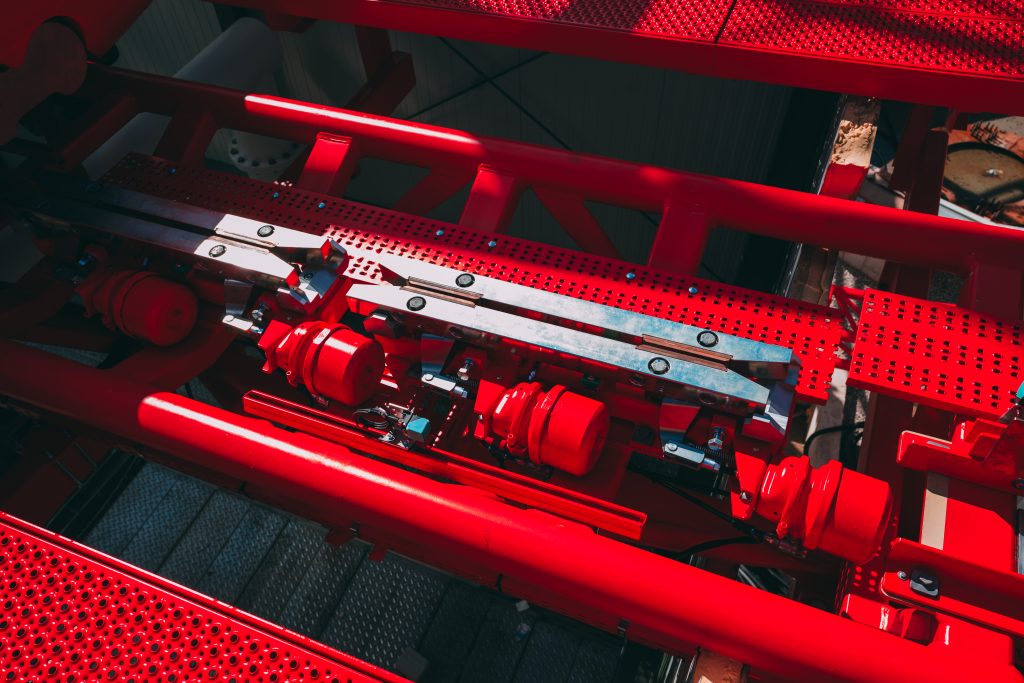
From the brake, the car returns directly to the station, with no detours and no unnecessary track. That keeps the total cycle time as short as possible, and on a ride with frequent single-car dispatches, every second saved per cycle adds up over a full operating day.
Then, the riders themselves. Guests who step out while they are still energised move faster. They unbuckle, stand up and leave the car more quickly than riders whose excitement has already faded on a looong return track. A shorter return keeps that energy alive, speeds up unloading and increases throughput.
One element, three effects: more excitement in the queue, shorter cycles and higher capacity.
06 · Looking back
The bold decisions
Looking back, the ride’s best moments all started as problems. The ghost train gave us the double down. The street gave us the Prater’s first coaster built over public ground. The lack of space gave us a loop that shares its footprint with the final curve. Every metre, every second and every emotion had to earn its place.
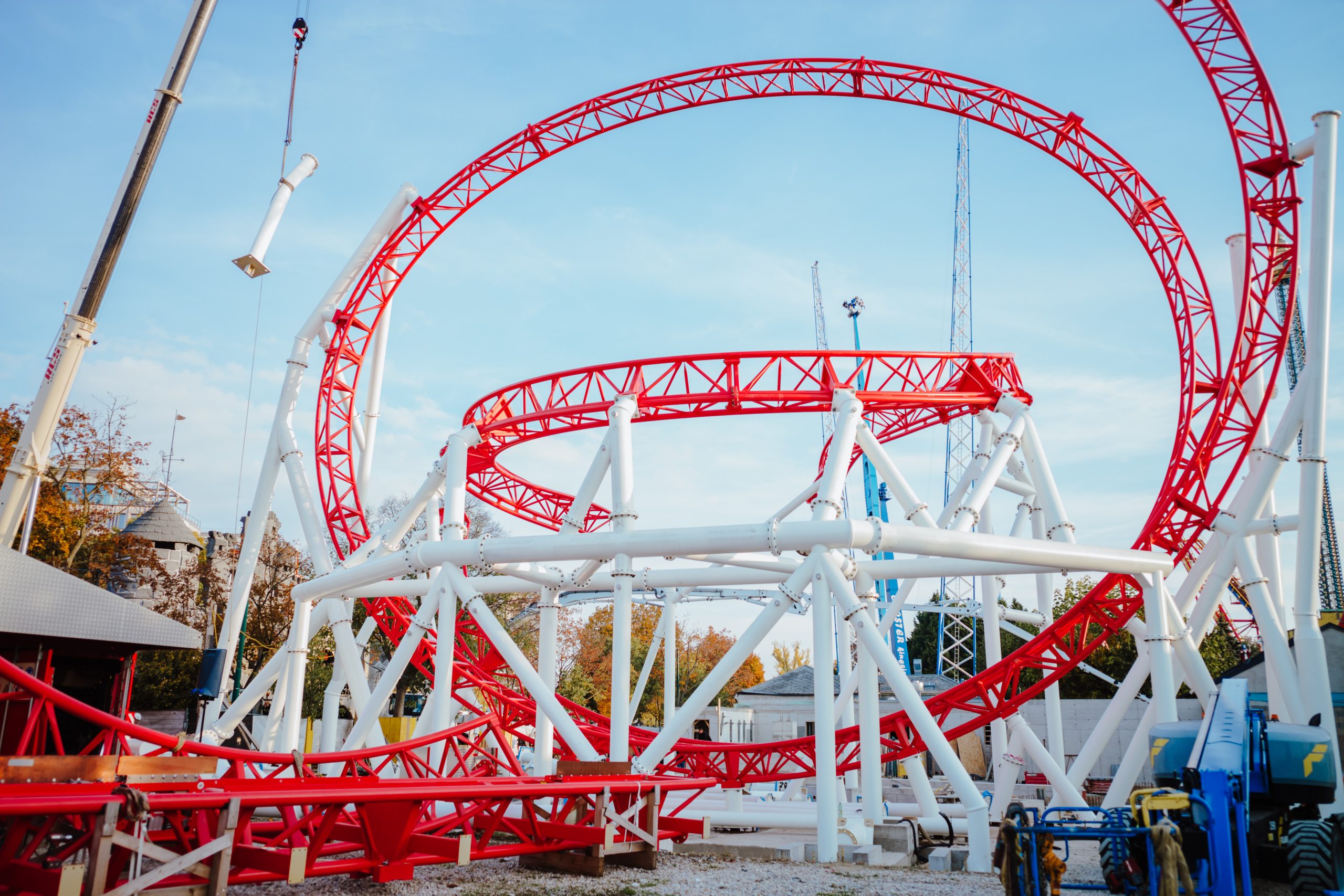
The boldest decision, however, was made before any track was drawn: to invest in a permanent new landmark and bring a quieter part of the Prater back to life. It was a decision driven by belief in the place – and in what a strong ride can do for everything around it..
Planning a new attraction on a site that seems too difficult? That is exactly the kind of project I enjoy. Get in touch
Next in this series All-Out on Red: the business case behind the Prater’s first modern flagship coaster